Hydraulic vs Electric Home Lifts: Which Should You Choose?
A practical comparison of the two main home lift drive systems — covering cost, space requirements, noise, energy use and maintenance for Australian homes.
If you are comparing home lifts in Australia, the first technical decision is the drive system: hydraulic or electric traction. The difference shapes everything — how much space you need, what the lift costs to install and run, how much noise it makes, and what ongoing maintenance looks like.
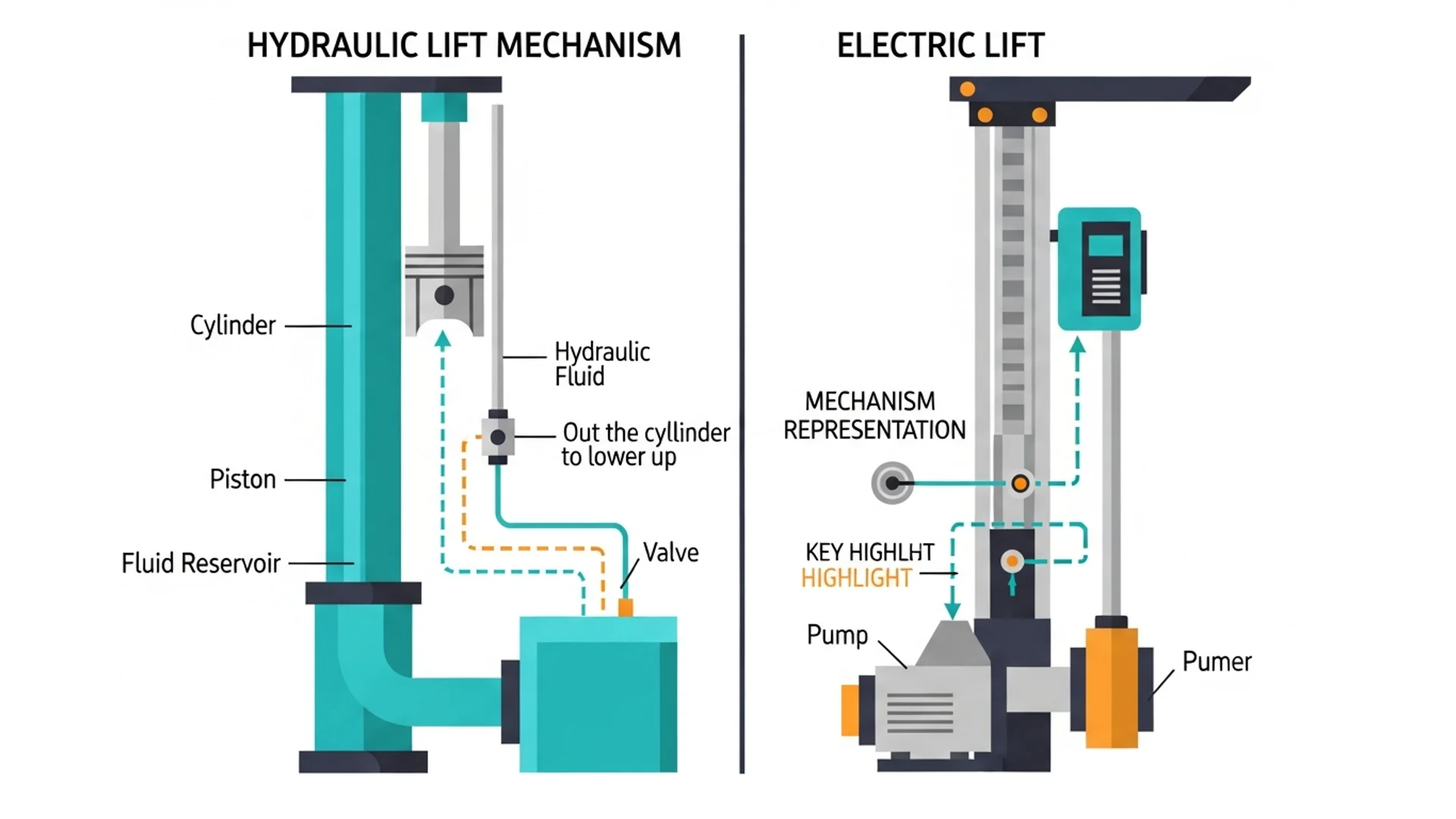
Hydraulic lifts use a pump, fluid reservoir and piston to raise and lower the cabin. Electric traction lifts (often called MRL — machine-room-less) use a motor, gearbox and steel ropes or belts. Both are covered by AS/NZS 1735.18:2002, the Australian Standard for passenger lifts in private residences, but they suit different homes and different priorities.
This page gives you a direct comparison so you can decide which system fits your situation before you request quotes.
The table below compares hydraulic and electric traction home lifts on the factors that matter most when choosing a drive system for a residential installation.
Swipe to compare →
| Factor | Hydraulic | Electric traction (MRL) |
|---|---|---|
| Best for | Low-rise homes (2–3 stops) where a quiet ride is less critical and retrofit space is available | Homes where energy efficiency, speed and a quieter ride matter — especially 3+ stops |
| Typical installed cost | $25,000–$55,000 ex GST (indicative, 2-stop) | $30,000–$65,000 ex GST (indicative, 2-stop) |
| Drive mechanism | Hydraulic pump, fluid reservoir and piston cylinder | Electric motor with steel ropes or flat belts — no hydraulic fluid |
| Requires a pit | Yes — typically 150–300mm deep | Varies — some models need a shallow pit (50–150mm), some are pit-less |
| Requires a machine room | Yes — a small utility space for the pump unit, usually at ground level near the shaft | No — motor is integrated into the shaft (machine-room-less) |
| Speed | 0.15–0.3 m/s typical for residential | 0.15–0.6 m/s typical for residential — faster options available |
| Noise level | Moderate — the hydraulic pump is audible during travel, especially on the up journey | Quieter — the electric motor and belt/rope system produce less noise |
| Energy consumption | Higher — pump runs continuously during the up journey; energy is not recovered on descent | Lower — motor draws power only as needed; some models use regenerative drives to recover energy on descent |
| Ride smoothness | Smooth but slower acceleration and deceleration | Smooth with faster, more responsive starts and stops |
| Travel height | Best suited to 2–3 stops (up to about 12m) | Suitable for 2–6+ stops — handles greater travel heights |
| Shaft space required | Shaft plus adjacent space for the pump unit | Shaft only — no separate machine room needed |
| Maintenance | Hydraulic fluid checks and replacement; pump and valve servicing; cylinder seal inspection | Rope/belt inspection and replacement; motor and controller servicing; fewer fluid-related tasks |
| Environmental | Hydraulic fluid requires careful disposal; higher energy use | No hydraulic fluid; lower running costs; some models partially offset grid draw with regenerative braking |
| Standby/emergency | Can lower cabin by gravity via manual valve release during power failure | Requires battery backup (UPS) for emergency lowering — standard on most residential models |
Cost ranges are indicative for a standard 2-stop residential installation in Australia, ex GST, and exclude building works (shaft construction, structural modifications, electrical supply upgrades). Actual costs vary by site, supplier and specification. Ranges based on published Australian cost guides and supplier-stated pricing; last checked April 2026.
Lift companies in Australia
Browse profiles, compare service areas, and check reviews.

Shotton Lifts
NDIS★ 5.0 (9 reviews)
Family-owned Australian lift manufacturer since 1977. 80+ staff. Design, engineer, manufacture, install and service from Dandenong South VIC. NDIS registered.
View profile →

LiftFit Australia
NDIS★ 5.0 (8 reviews)
Victoria-based NDIS registered lift provider, est. 2011. Partners with Cibes, Savaria, and Kalea. Residential, commercial, and platform lifts.
View profile →

Easy Living Home Elevators
★ 5.0 (7 reviews)
Australia's #1 home elevator supplier since 1998. 100% Australian-owned. 11,000+ elevators in service across 6 states.
View profile →
EcoLift
★ 5.0 (3 reviews)
Family-owned Sydney lift company. European-parts-based installations for reliability and cost-efficient servicing.
View profile →

Sunshine Coast Elevators
★ 5.0 (3 reviews)
Sunshine Coast QLD specialist in bespoke Italian-made residential elevators and disability access lifts. 38+ years industry experience.
View profile →
EMS Elevator Group
★ 5.0 (2 reviews)
Sydney-based bespoke elevator company specialising in installation, modernisation, and maintenance. 24/7 support.
View profile →
LiftQuotes is a comparison platform. Companies shown are filtered by relevance to this page. Listing does not imply endorsement. LiftQuotes may receive a referral fee when you request quotes.
How hydraulic home lifts work
A hydraulic lift raises the cabin by pumping fluid into a cylinder beneath or beside it. A motor-driven pump pressurises the hydraulic oil, extending a piston that pushes the cabin upward. To descend, a valve releases fluid back into the reservoir — the cabin lowers under its own weight, controlled by the valve.
The pump unit sits in a small utility area (the machine room) adjacent to the shaft, usually at the lowest landing. The system needs a pit — typically 150–300mm deep — to house the piston at its lowest point.
Hydraulic systems have been used in lifts for decades. They are mechanically straightforward, which can mean simpler fault diagnosis and repair. The trade-off is higher energy consumption (the pump runs throughout the entire up journey) and a requirement for periodic hydraulic fluid checks and replacement.
How electric traction home lifts work
An electric traction lift uses a motor mounted at the top of the shaft (or within it) connected to the cabin by steel ropes or flat polyurethane belts. The motor turns a sheave that moves the ropes, raising or lowering the cabin against a counterweight.
Because the motor fits inside the shaft, there is no separate machine room — hence the industry term MRL (machine-room-less). Pit requirements are minimal: some models need only 50mm, and a few are designed to be pit-less.
Electric traction is now the dominant technology in new residential installations globally. It draws power only when the motor is active, and some models recover energy during descent through regenerative braking. The result is lower running costs and reduced environmental impact compared to hydraulic systems.
Choose hydraulic lift if
- ✓You have a low-rise home (2 stops) and speed is not a priority.
- ✓You have space for a small machine room adjacent to the shaft at ground level.
- ✓You want the simplest emergency lowering — hydraulic lifts descend by gravity when the manual valve is released, with no battery required.
- ✓Your site already has a prepared pit of 150–300mm depth.
- ✓You prefer a drive technology with a long local service history — many Australian lift technicians are experienced with hydraulic systems.
Choose an electric traction lift if
- ✓You want a quieter lift — electric motors and belt drives produce less noise than hydraulic pumps.
- ✓Energy efficiency matters — electric traction uses significantly less power, and regenerative models recover energy on descent.
- ✓You need faster travel speed — electric traction offers 0.3–0.6 m/s residential options, useful for 3+ stops.
- ✓Your home cannot accommodate a machine room — MRL designs keep everything within the shaft.
- ✓You want a shallower or no pit — some electric models need only 50mm or are pit-less, which simplifies retrofit projects.
- ✓You are building or renovating for the long term — lower running costs and reduced maintenance complexity favour electric traction over the life of the lift.
Cost comparison in detail
A hydraulic home lift typically starts lower on purchase price — expect an indicative range of $25,000–$55,000 ex GST for a standard 2-stop installation, based on published Australian cost guides (hipages, supplier pricing; last checked April 2026). Electric traction models tend to start slightly higher at $30,000–$65,000 ex GST for a comparable installation, reflecting the more advanced motor and control technology.
However, the purchase price is only part of the picture. Electric traction lifts generally cost less to run (lower electricity consumption, no hydraulic fluid replacement) and may require fewer service visits focused on fluid-related maintenance. Over a 15–20 year ownership period, the difference in running costs can narrow or reverse the initial price gap.
Building works are the biggest variable for both systems. Constructing a new shaft, reinforcing floors, or excavating a deeper pit can add $5,000–$20,000+ to either option. Electric traction's smaller pit and no machine room requirement can reduce building works in retrofit scenarios — a significant advantage in existing Australian homes where space is tight.
Standards and compliance
Both hydraulic and electric traction home lifts in Australia must comply with AS/NZS 1735.18:2002 — the Australian Standard covering automatically controlled passenger lifts in private residences. This standard sets requirements for safety devices, emergency operation, car dimensions and controls regardless of drive type.
In most states and territories, lifts are classified as registrable plant under Schedule 5 of the model Work Health and Safety (WHS) Regulations. This means both the design and each installed unit require registration with your state regulator — SafeWork NSW, WorkSafe Victoria (which operates under OHS, not model WHS), WHSQ in Queensland, or the equivalent authority in your jurisdiction.
Your lift installer should handle the registration process, but it is worth confirming this is included in the quoted scope of works.
Still deciding? Get quotes for both options
Installers will assess your site and recommend the right specification.
What are you looking for today?
I need a lift installed
I have a lift that needs attention
If you are comparing home lifts in Australia, the first technical decision is the drive system: hydraulic or electric traction. The difference shapes everything — how much space you need, what the lift costs to install and run, how much noise it makes, and what ongoing maintenance looks like.
Hydraulic lifts use a pump, fluid reservoir and piston to raise and lower the cabin. Electric traction lifts (often called MRL — machine-room-less) use a motor, gearbox and steel ropes or belts. Both are covered by AS/NZS 1735.18:2002, the Australian Standard for passenger lifts in private residences, but they suit different homes and different priorities.
This page gives you a direct comparison so you can decide which system fits your situation before you request quotes.
The table below compares hydraulic and electric traction home lifts on the factors that matter most when choosing a drive system for a residential installation.
Swipe to compare →
| Factor | Hydraulic | Electric traction (MRL) |
|---|---|---|
| Best for | Low-rise homes (2–3 stops) where a quiet ride is less critical and retrofit space is available | Homes where energy efficiency, speed and a quieter ride matter — especially 3+ stops |
| Typical installed cost | $25,000–$55,000 ex GST (indicative, 2-stop) | $30,000–$65,000 ex GST (indicative, 2-stop) |
| Drive mechanism | Hydraulic pump, fluid reservoir and piston cylinder | Electric motor with steel ropes or flat belts — no hydraulic fluid |
| Requires a pit | Yes — typically 150–300mm deep | Varies — some models need a shallow pit (50–150mm), some are pit-less |
| Requires a machine room | Yes — a small utility space for the pump unit, usually at ground level near the shaft | No — motor is integrated into the shaft (machine-room-less) |
| Speed | 0.15–0.3 m/s typical for residential | 0.15–0.6 m/s typical for residential — faster options available |
| Noise level | Moderate — the hydraulic pump is audible during travel, especially on the up journey | Quieter — the electric motor and belt/rope system produce less noise |
| Energy consumption | Higher — pump runs continuously during the up journey; energy is not recovered on descent | Lower — motor draws power only as needed; some models use regenerative drives to recover energy on descent |
| Ride smoothness | Smooth but slower acceleration and deceleration | Smooth with faster, more responsive starts and stops |
| Travel height | Best suited to 2–3 stops (up to about 12m) | Suitable for 2–6+ stops — handles greater travel heights |
| Shaft space required | Shaft plus adjacent space for the pump unit | Shaft only — no separate machine room needed |
| Maintenance | Hydraulic fluid checks and replacement; pump and valve servicing; cylinder seal inspection | Rope/belt inspection and replacement; motor and controller servicing; fewer fluid-related tasks |
| Environmental | Hydraulic fluid requires careful disposal; higher energy use | No hydraulic fluid; lower running costs; some models partially offset grid draw with regenerative braking |
| Standby/emergency | Can lower cabin by gravity via manual valve release during power failure | Requires battery backup (UPS) for emergency lowering — standard on most residential models |
Cost ranges are indicative for a standard 2-stop residential installation in Australia, ex GST, and exclude building works (shaft construction, structural modifications, electrical supply upgrades). Actual costs vary by site, supplier and specification. Ranges based on published Australian cost guides and supplier-stated pricing; last checked April 2026.
Lift companies in Australia
Browse profiles, compare service areas, and check reviews.
Shotton Lifts
NDIS★ 5.0 (9 reviews)
Family-owned Australian lift manufacturer since 1977. 80+ staff. Design, engineer, manufacture, install and service from Dandenong South VIC. NDIS registered.
View profile →
LiftFit Australia
NDIS★ 5.0 (8 reviews)
Victoria-based NDIS registered lift provider, est. 2011. Partners with Cibes, Savaria, and Kalea. Residential, commercial, and platform lifts.
View profile →
Easy Living Home Elevators
★ 5.0 (7 reviews)
Australia's #1 home elevator supplier since 1998. 100% Australian-owned. 11,000+ elevators in service across 6 states.
View profile →
EcoLift
★ 5.0 (3 reviews)
Family-owned Sydney lift company. European-parts-based installations for reliability and cost-efficient servicing.
View profile →
Sunshine Coast Elevators
★ 5.0 (3 reviews)
Sunshine Coast QLD specialist in bespoke Italian-made residential elevators and disability access lifts. 38+ years industry experience.
View profile →
EMS Elevator Group
★ 5.0 (2 reviews)
Sydney-based bespoke elevator company specialising in installation, modernisation, and maintenance. 24/7 support.
View profile →
LiftQuotes is a comparison platform. Companies shown are filtered by relevance to this page. Listing does not imply endorsement. LiftQuotes may receive a referral fee when you request quotes.
How hydraulic home lifts work
A hydraulic lift raises the cabin by pumping fluid into a cylinder beneath or beside it. A motor-driven pump pressurises the hydraulic oil, extending a piston that pushes the cabin upward. To descend, a valve releases fluid back into the reservoir — the cabin lowers under its own weight, controlled by the valve.
The pump unit sits in a small utility area (the machine room) adjacent to the shaft, usually at the lowest landing. The system needs a pit — typically 150–300mm deep — to house the piston at its lowest point.
Hydraulic systems have been used in lifts for decades. They are mechanically straightforward, which can mean simpler fault diagnosis and repair. The trade-off is higher energy consumption (the pump runs throughout the entire up journey) and a requirement for periodic hydraulic fluid checks and replacement.
How electric traction home lifts work
An electric traction lift uses a motor mounted at the top of the shaft (or within it) connected to the cabin by steel ropes or flat polyurethane belts. The motor turns a sheave that moves the ropes, raising or lowering the cabin against a counterweight.
Because the motor fits inside the shaft, there is no separate machine room — hence the industry term MRL (machine-room-less). Pit requirements are minimal: some models need only 50mm, and a few are designed to be pit-less.
Electric traction is now the dominant technology in new residential installations globally. It draws power only when the motor is active, and some models recover energy during descent through regenerative braking. The result is lower running costs and reduced environmental impact compared to hydraulic systems.
Choose hydraulic lift if
- ✓You have a low-rise home (2 stops) and speed is not a priority.
- ✓You have space for a small machine room adjacent to the shaft at ground level.
- ✓You want the simplest emergency lowering — hydraulic lifts descend by gravity when the manual valve is released, with no battery required.
- ✓Your site already has a prepared pit of 150–300mm depth.
- ✓You prefer a drive technology with a long local service history — many Australian lift technicians are experienced with hydraulic systems.
Choose an electric traction lift if
- ✓You want a quieter lift — electric motors and belt drives produce less noise than hydraulic pumps.
- ✓Energy efficiency matters — electric traction uses significantly less power, and regenerative models recover energy on descent.
- ✓You need faster travel speed — electric traction offers 0.3–0.6 m/s residential options, useful for 3+ stops.
- ✓Your home cannot accommodate a machine room — MRL designs keep everything within the shaft.
- ✓You want a shallower or no pit — some electric models need only 50mm or are pit-less, which simplifies retrofit projects.
- ✓You are building or renovating for the long term — lower running costs and reduced maintenance complexity favour electric traction over the life of the lift.
Cost comparison in detail
A hydraulic home lift typically starts lower on purchase price — expect an indicative range of $25,000–$55,000 ex GST for a standard 2-stop installation, based on published Australian cost guides (hipages, supplier pricing; last checked April 2026). Electric traction models tend to start slightly higher at $30,000–$65,000 ex GST for a comparable installation, reflecting the more advanced motor and control technology.
However, the purchase price is only part of the picture. Electric traction lifts generally cost less to run (lower electricity consumption, no hydraulic fluid replacement) and may require fewer service visits focused on fluid-related maintenance. Over a 15–20 year ownership period, the difference in running costs can narrow or reverse the initial price gap.
Building works are the biggest variable for both systems. Constructing a new shaft, reinforcing floors, or excavating a deeper pit can add $5,000–$20,000+ to either option. Electric traction's smaller pit and no machine room requirement can reduce building works in retrofit scenarios — a significant advantage in existing Australian homes where space is tight.
Standards and compliance
Both hydraulic and electric traction home lifts in Australia must comply with AS/NZS 1735.18:2002 — the Australian Standard covering automatically controlled passenger lifts in private residences. This standard sets requirements for safety devices, emergency operation, car dimensions and controls regardless of drive type.
In most states and territories, lifts are classified as registrable plant under Schedule 5 of the model Work Health and Safety (WHS) Regulations. This means both the design and each installed unit require registration with your state regulator — SafeWork NSW, WorkSafe Victoria (which operates under OHS, not model WHS), WHSQ in Queensland, or the equivalent authority in your jurisdiction.
Your lift installer should handle the registration process, but it is worth confirming this is included in the quoted scope of works.
Still deciding? Get quotes for both options
Installers will assess your site and recommend the right specification.
What are you looking for today?
I need a lift installed
I have a lift that needs attention
Space requirements
Hydraulic lifts need a machine room plus a 150–300mm pit. Electric traction lifts fit everything inside the shaft and often need only a shallow pit (50mm) or none at all — a major advantage for retrofitting existing homes.
Running costs
Electric traction lifts use less power and have no hydraulic fluid to replace. Over 15–20 years, running cost savings can offset a higher upfront price.
Noise
Hydraulic pumps are audible during travel, especially on the way up. Electric motor and belt systems are noticeably quieter — an important factor if the lift shaft is near bedrooms or living areas.
Emergency operation
Hydraulic lifts lower by gravity when a manual valve is opened — no battery needed. Electric lifts require a battery backup (UPS) for emergency lowering, which is standard on most residential models but adds a component to maintain.
Common questions about hydraulic and electric home lifts
Hydraulic home lifts have a lower upfront cost for simple 2-stop installations, a long track record with widely available service technicians, and the simplest emergency lowering system — the cabin descends by gravity when a manual valve is released, with no battery required. They are a proven, mechanically straightforward option for low-rise homes.
Related guides
Location
Commercial Lifts Melbourne: Costs, Compliance & Installers
Commercial lift costs, Victorian OHS compliance and the Melbourne installer market — indicative prices, WorkSafe Victoria rules and NCC requirements for VIC projects.
Location
Commercial Lifts Sydney: Costs, Compliance & Installers
Commercial lift costs, NSW compliance and the Sydney installer market — indicative prices, SafeWork NSW rules and NCC requirements for CBD and metro projects.
Guide
What Size Lift Do I Need for a Wheelchair? (Australia)
A home lift for a wheelchair needs roughly 1,100 x 1,400 mm inside and a 900 mm clear door. See minimum sizes for a wheelchair, a carer, and turning space.
Guide
Support at Home & Lift Funding: The 2026 Guide
Can Support at Home fund a home lift or stairlift? How aged care funding works, the OT assessment, means-tested contributions, and how it differs from the NDIS.
Ready to compare lift quotes?
Get free, no-obligation quotes from Australian lift installers who can advise on the right drive system for your home and budget.
Join 1,000+ Australians who've requested quotes through LiftQuotes
Get free quotes