
Small & Compact Lifts for Australian Homes
The smallest home lift footprints start at under 700mm wide. Here are the compact options that fit tight spaces — with real dimensions, costs, and trade-offs.
The smallest home lift available in Australia fits inside a footprint of just 695mm x 755mm — smaller than a standard shower base. Several compact lift types work in homes where a full-size shaft is not feasible, including through-floor lifts, pneumatic vacuum lifts, and compact screw-drive models.
The trade-off with compact lifts is always between size, capacity, and wheelchair accessibility. The most space-efficient models carry one standing passenger. If the lift needs to fit a wheelchair, the minimum cabin size under AS 1735.12:2020 is 1,100mm x 1,400mm — which still represents a modest footprint of around 1.5m² for the shaft. This guide covers the specific dimensions, costs, and limitations of each compact option so you can match the right lift to your available space.
The four smallest home lift types
Not every home has room for a full-size lift shaft. Narrow terrace houses, split-level homes, and compact two-storey floor plans may rule out a standard 1,500mm x 1,500mm shaft entirely. Several lift types are designed specifically for these tight spaces, and the differences between them matter.
The four most compact options available to Australian homeowners are through-floor lifts, pneumatic vacuum lifts, compact screw-drive lifts, and small-footprint hydraulic lifts. Each makes different trade-offs between size, speed, capacity, and cost. For general information on all residential lift types, see the home lifts guide.
Through-floor lifts
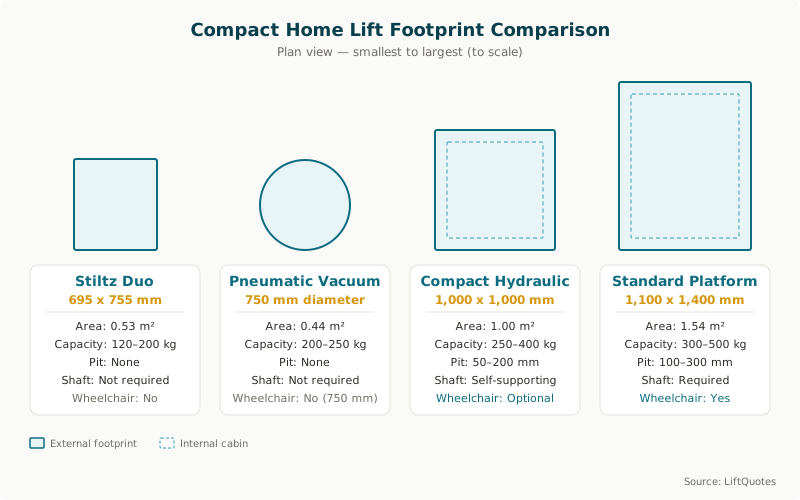
Through-floor lifts are the smallest option on the market. The Stiltz Duo, one of the most popular models in Australia, has an external footprint of just 695mm x 755mm — roughly the size of an office chair mat. It cuts through the floor between two levels using a screw-drive mechanism within a self-supporting tower.
No shaft, pit, or machine room is required. The tower is freestanding and anchored at each floor level. Installation typically takes 1–3 days with minimal structural work, making it one of the least disruptive lift installations available.
Limitations: Most through-floor lifts carry a single standing passenger (up to 120–200 kg). They are not wheelchair accessible. Speed is slow — around 0.08–0.15 m/s. Travel is limited to two stops (one floor).
Pneumatic vacuum lifts
Pneumatic vacuum lifts use air pressure to move the cabin up and down inside a transparent polycarbonate cylinder. The 750mm single-passenger model has an external diameter of around 900mm — a circular footprint of 0.64m².
The key advantage is zero structural work: no shaft, no pit, no machine room. The cylinder sits directly on the finished floor and can be installed in a day. For a deeper look at how the technology works, read the vacuum lifts Australia guide.
Larger models (up to 1,300mm internal diameter) can accommodate a wheelchair, though they require more floor space and carry a higher price tag — typically $45,000–$60,000 installed (indicative, ex GST; based on supplier-stated pricing, April 2026).
Limitations: Weight capacity is lower than conventional lifts (200–250 kg for most models). Maximum travel is 4 stops. The vacuum pump generates noticeable noise during operation — comparable to a domestic vacuum cleaner for 20–30 seconds per trip.
Compact screw-drive and hydraulic lifts
If you need more capacity than a through-floor lift but less floor space than a conventional shaft lift, compact screw-drive and small hydraulic models fill the gap. Shaft footprints start at around 1,000mm x 1,000mm for screw-drive models and 1,200mm x 1,200mm for compact hydraulics.
Screw-drive lifts use a self-supporting structure and do not need a load-bearing built shaft. A 50–70mm ramp threshold replaces the traditional pit. These models carry 250–400 kg and travel at 0.1–0.15 m/s.
Compact hydraulic lifts need a shallow pit (100–200mm) and either a built shaft or a self-supporting metal structure. They offer higher weight capacity (up to 500 kg) and slightly faster travel speeds. For full dimension details across all drive types, see the home lift space requirements guide.
Can a compact lift fit a wheelchair?
The short answer: the smallest lifts cannot. A standard manual wheelchair needs a cabin of at least 1,100mm x 1,400mm (per AS 1735.12:2020), which requires a shaft or structure footprint of roughly 1,400mm x 1,600mm. That eliminates through-floor lifts and the smallest vacuum models.
The most compact wheelchair-accessible options are:
- Vacuum lift (1,300mm diameter model): Fits a standard wheelchair. External footprint approximately 1,500mm circular. No shaft or pit.
- Platform lift: Minimum platform 1,100mm x 1,400mm. Shaft footprint from 1,400mm x 1,600mm. Some models are self-supporting.
- Compact screw-drive lift: Cabin sizes from 1,100mm x 1,400mm available. Self-supporting structure, 50mm ramp entry.
If accessibility is not required now but may be in future, consider installing a lift with a larger cabin from the outset. Retrofitting a larger lift later costs significantly more than sizing up during the initial installation.
What compact lifts cost
As of Q2 2026, indicative installed costs for compact home lifts in Australia (ex GST):
- Through-floor lift (single passenger): $25,000–$35,000
- Pneumatic vacuum lift (750mm): $35,000–$50,000
- Compact screw-drive lift: $30,000–$50,000
- Small hydraulic lift (2-stop): $35,000–$60,000
- Wheelchair-accessible compact lift: $40,000–$70,000
These ranges include the lift equipment and standard installation. Building works — structural modifications, floor penetrations, electrical upgrades — can add $5,000–$25,000 depending on the construction type and access conditions. For a full breakdown of what drives the cost up or down, read the home lift cost guide.
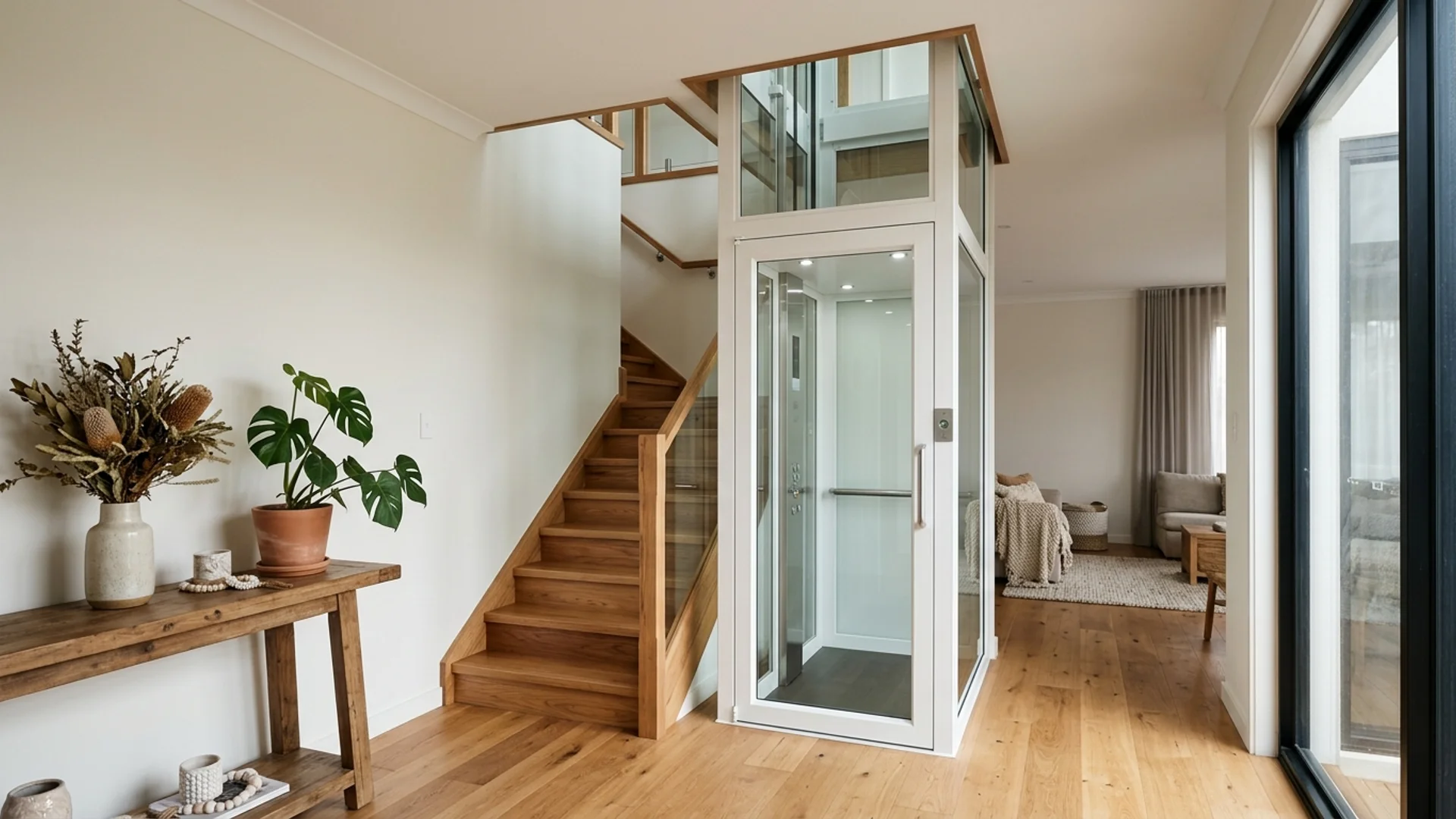
Getting quotes from multiple installers is the most reliable way to understand what a compact lift will cost for your specific situation. Each home has different structural constraints, access conditions, and compliance requirements that affect the final price. Request free quotes from verified Australian lift suppliers.
Lift companies in Australia
Browse profiles, compare service areas, and check reviews.

Shotton Lifts
NDIS★ 5.0 (9 reviews)
Family-owned Australian lift manufacturer since 1977. 80+ staff. Design, engineer, manufacture, install and service from Dandenong South VIC. NDIS registered.
View profile →

LiftFit Australia
NDIS★ 5.0 (8 reviews)
Victoria-based NDIS registered lift provider, est. 2011. Partners with Cibes, Savaria, and Kalea. Residential, commercial, and platform lifts.
View profile →

Easy Living Home Elevators
★ 5.0 (7 reviews)
Australia's #1 home elevator supplier since 1998. 100% Australian-owned. 11,000+ elevators in service across 6 states.
View profile →

EcoLift
★ 5.0 (3 reviews)
Family-owned Sydney lift company. European-parts-based installations for reliability and cost-efficient servicing.
View profile →

Sunshine Coast Elevators
★ 5.0 (3 reviews)
Sunshine Coast QLD specialist in bespoke Italian-made residential elevators and disability access lifts. 38+ years industry experience.
View profile →

EMS Elevator Group
★ 5.0 (2 reviews)
Sydney-based bespoke elevator company specialising in installation, modernisation, and maintenance. 24/7 support.
View profile →
LiftQuotes is a comparison platform. Companies shown are filtered by relevance to this page. Listing does not imply endorsement. LiftQuotes may receive a referral fee when you request quotes.
Put this into action
When you're ready to move forward, get free quotes from verified Australian lift installers.
What are you looking for today?
I need a lift installed
I have a lift that needs attention
The smallest home lift available in Australia fits inside a footprint of just 695mm x 755mm — smaller than a standard shower base. Several compact lift types work in homes where a full-size shaft is not feasible, including through-floor lifts, pneumatic vacuum lifts, and compact screw-drive models.
The trade-off with compact lifts is always between size, capacity, and wheelchair accessibility. The most space-efficient models carry one standing passenger. If the lift needs to fit a wheelchair, the minimum cabin size under AS 1735.12:2020 is 1,100mm x 1,400mm — which still represents a modest footprint of around 1.5m² for the shaft. This guide covers the specific dimensions, costs, and limitations of each compact option so you can match the right lift to your available space.
The four smallest home lift types
Not every home has room for a full-size lift shaft. Narrow terrace houses, split-level homes, and compact two-storey floor plans may rule out a standard 1,500mm x 1,500mm shaft entirely. Several lift types are designed specifically for these tight spaces, and the differences between them matter.
The four most compact options available to Australian homeowners are through-floor lifts, pneumatic vacuum lifts, compact screw-drive lifts, and small-footprint hydraulic lifts. Each makes different trade-offs between size, speed, capacity, and cost. For general information on all residential lift types, see the home lifts guide.
Through-floor lifts
Through-floor lifts are the smallest option on the market. The Stiltz Duo, one of the most popular models in Australia, has an external footprint of just 695mm x 755mm — roughly the size of an office chair mat. It cuts through the floor between two levels using a screw-drive mechanism within a self-supporting tower.
No shaft, pit, or machine room is required. The tower is freestanding and anchored at each floor level. Installation typically takes 1–3 days with minimal structural work, making it one of the least disruptive lift installations available.
Limitations: Most through-floor lifts carry a single standing passenger (up to 120–200 kg). They are not wheelchair accessible. Speed is slow — around 0.08–0.15 m/s. Travel is limited to two stops (one floor).
Pneumatic vacuum lifts
Pneumatic vacuum lifts use air pressure to move the cabin up and down inside a transparent polycarbonate cylinder. The 750mm single-passenger model has an external diameter of around 900mm — a circular footprint of 0.64m².
The key advantage is zero structural work: no shaft, no pit, no machine room. The cylinder sits directly on the finished floor and can be installed in a day. For a deeper look at how the technology works, read the vacuum lifts Australia guide.
Larger models (up to 1,300mm internal diameter) can accommodate a wheelchair, though they require more floor space and carry a higher price tag — typically $45,000–$60,000 installed (indicative, ex GST; based on supplier-stated pricing, April 2026).
Limitations: Weight capacity is lower than conventional lifts (200–250 kg for most models). Maximum travel is 4 stops. The vacuum pump generates noticeable noise during operation — comparable to a domestic vacuum cleaner for 20–30 seconds per trip.
Compact screw-drive and hydraulic lifts
If you need more capacity than a through-floor lift but less floor space than a conventional shaft lift, compact screw-drive and small hydraulic models fill the gap. Shaft footprints start at around 1,000mm x 1,000mm for screw-drive models and 1,200mm x 1,200mm for compact hydraulics.
Screw-drive lifts use a self-supporting structure and do not need a load-bearing built shaft. A 50–70mm ramp threshold replaces the traditional pit. These models carry 250–400 kg and travel at 0.1–0.15 m/s.
Compact hydraulic lifts need a shallow pit (100–200mm) and either a built shaft or a self-supporting metal structure. They offer higher weight capacity (up to 500 kg) and slightly faster travel speeds. For full dimension details across all drive types, see the home lift space requirements guide.
Can a compact lift fit a wheelchair?
The short answer: the smallest lifts cannot. A standard manual wheelchair needs a cabin of at least 1,100mm x 1,400mm (per AS 1735.12:2020), which requires a shaft or structure footprint of roughly 1,400mm x 1,600mm. That eliminates through-floor lifts and the smallest vacuum models.
The most compact wheelchair-accessible options are:
- Vacuum lift (1,300mm diameter model): Fits a standard wheelchair. External footprint approximately 1,500mm circular. No shaft or pit.
- Platform lift: Minimum platform 1,100mm x 1,400mm. Shaft footprint from 1,400mm x 1,600mm. Some models are self-supporting.
- Compact screw-drive lift: Cabin sizes from 1,100mm x 1,400mm available. Self-supporting structure, 50mm ramp entry.
If accessibility is not required now but may be in future, consider installing a lift with a larger cabin from the outset. Retrofitting a larger lift later costs significantly more than sizing up during the initial installation.
What compact lifts cost
As of Q2 2026, indicative installed costs for compact home lifts in Australia (ex GST):
- Through-floor lift (single passenger): $25,000–$35,000
- Pneumatic vacuum lift (750mm): $35,000–$50,000
- Compact screw-drive lift: $30,000–$50,000
- Small hydraulic lift (2-stop): $35,000–$60,000
- Wheelchair-accessible compact lift: $40,000–$70,000
These ranges include the lift equipment and standard installation. Building works — structural modifications, floor penetrations, electrical upgrades — can add $5,000–$25,000 depending on the construction type and access conditions. For a full breakdown of what drives the cost up or down, read the home lift cost guide.
Getting quotes from multiple installers is the most reliable way to understand what a compact lift will cost for your specific situation. Each home has different structural constraints, access conditions, and compliance requirements that affect the final price. Request free quotes from verified Australian lift suppliers.
Lift companies in Australia
Browse profiles, compare service areas, and check reviews.
Shotton Lifts
NDIS★ 5.0 (9 reviews)
Family-owned Australian lift manufacturer since 1977. 80+ staff. Design, engineer, manufacture, install and service from Dandenong South VIC. NDIS registered.
View profile →
LiftFit Australia
NDIS★ 5.0 (8 reviews)
Victoria-based NDIS registered lift provider, est. 2011. Partners with Cibes, Savaria, and Kalea. Residential, commercial, and platform lifts.
View profile →
Easy Living Home Elevators
★ 5.0 (7 reviews)
Australia's #1 home elevator supplier since 1998. 100% Australian-owned. 11,000+ elevators in service across 6 states.
View profile →
EcoLift
★ 5.0 (3 reviews)
Family-owned Sydney lift company. European-parts-based installations for reliability and cost-efficient servicing.
View profile →
Sunshine Coast Elevators
★ 5.0 (3 reviews)
Sunshine Coast QLD specialist in bespoke Italian-made residential elevators and disability access lifts. 38+ years industry experience.
View profile →
EMS Elevator Group
★ 5.0 (2 reviews)
Sydney-based bespoke elevator company specialising in installation, modernisation, and maintenance. 24/7 support.
View profile →
LiftQuotes is a comparison platform. Companies shown are filtered by relevance to this page. Listing does not imply endorsement. LiftQuotes may receive a referral fee when you request quotes.
Put this into action
When you're ready to move forward, get free quotes from verified Australian lift installers.
What are you looking for today?
I need a lift installed
I have a lift that needs attention
Footprints from 695mm x 755mm
Through-floor lifts like the Stiltz Duo need less than 0.53m² of floor space — smaller than a wardrobe. No shaft construction required.
No pit or shaft for some types
Pneumatic vacuum lifts and through-floor screw-drive lifts are self-supporting. They sit directly on the finished floor with no pit, shaft, or machine room.
Wheelchair options from 1.1m x 1.4m
Compact wheelchair-accessible lifts exist, but the AS 1735.12 minimum cabin size means a shaft footprint of at least 1.4m x 1.6m.
Costs from $25,000 installed
Compact through-floor lifts start around $25,000–$35,000. Vacuum lifts sit at $35,000–$55,000. As of Q2 2026, indicative pricing ex GST.
Common questions about compact home lifts
The smallest compact home lifts start at a footprint of just 695mm x 755mm — about half a square metre. Through-floor lifts and pneumatic vacuum lifts are self-supporting, meaning they sit directly on the floor with no separate shaft or pit. If the lift needs to accommodate a wheelchair, the minimum cabin size under AS 1735.12:2020 is 1,100mm x 1,400mm, requiring a footprint of around 1.4m x 1.6m.
Related guides
Location
Commercial Lifts Melbourne: Costs, Compliance & Installers
Commercial lift costs, Victorian OHS compliance and the Melbourne installer market — indicative prices, WorkSafe Victoria rules and NCC requirements for VIC projects.
Location
Commercial Lifts Sydney: Costs, Compliance & Installers
Commercial lift costs, NSW compliance and the Sydney installer market — indicative prices, SafeWork NSW rules and NCC requirements for CBD and metro projects.
Guide
What Size Lift Do I Need for a Wheelchair? (Australia)
A home lift for a wheelchair needs roughly 1,100 x 1,400 mm inside and a 900 mm clear door. See minimum sizes for a wheelchair, a carer, and turning space.
Guide
Support at Home & Lift Funding: The 2026 Guide
Can Support at Home fund a home lift or stairlift? How aged care funding works, the OT assessment, means-tested contributions, and how it differs from the NDIS.
Need a lift that fits a tight space?
Tell us your available dimensions and requirements. Get free, no-obligation quotes from verified Australian lift suppliers who specialise in compact installations.
Join 1,000+ Australians who've requested quotes through LiftQuotes
Get free quotes