Home Lift Installation Guide for Australian Homes
The full process from site assessment to commissioning — timelines, stages, and what your builder and lift installer each handle.
Installing a home lift is less disruptive than most homeowners expect. The lift itself typically goes in within 1 to 5 days once the shaft or structural opening is ready. The building works — forming the shaft, pouring a pit, cutting floor openings — take longer and vary more, from a few days in a new build to 2–4 weeks for a complex retrofit.
The total project timeline from signed contract to a working lift is usually 8–16 weeks. Most of that time is manufacturing and lead time, not active work in your home. This guide breaks down each stage so you know what happens, who is responsible, and where the common delays occur.
The installation stages
A home lift installation follows a predictable sequence regardless of lift type. Understanding each stage helps you plan around disruption and coordinate between your builder and the lift supplier.
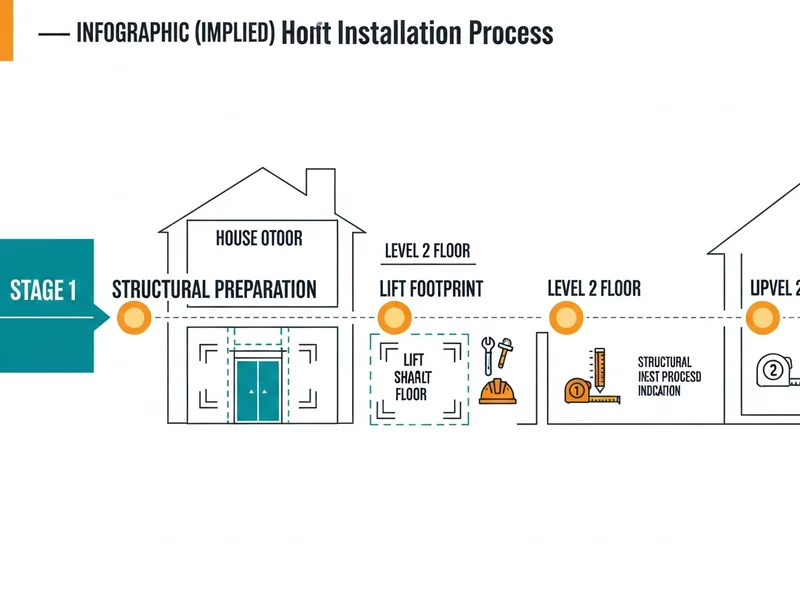
Stage 1 — Site assessment and quotation (1–2 weeks)
The lift supplier visits your home to measure the proposed location, assess structural conditions, and confirm which models fit. They need your floor-to-floor height, available footprint, ceiling height, and floor construction type. If you have not already had a structural assessment, they may recommend one before quoting.
For detailed dimension requirements, see our home lift space requirements guide.
Stage 2 — Contract and manufacturing (6–12 weeks)
Once you accept a quote, the lift goes into production. European-manufactured lifts (common in Australia from brands like Cibes, Aritco, and Stannah) typically have 8–12 week lead times. Locally assembled models or simpler platform lifts may arrive in 4–6 weeks.
This is the longest phase — and the best time for your builder to complete the structural works.
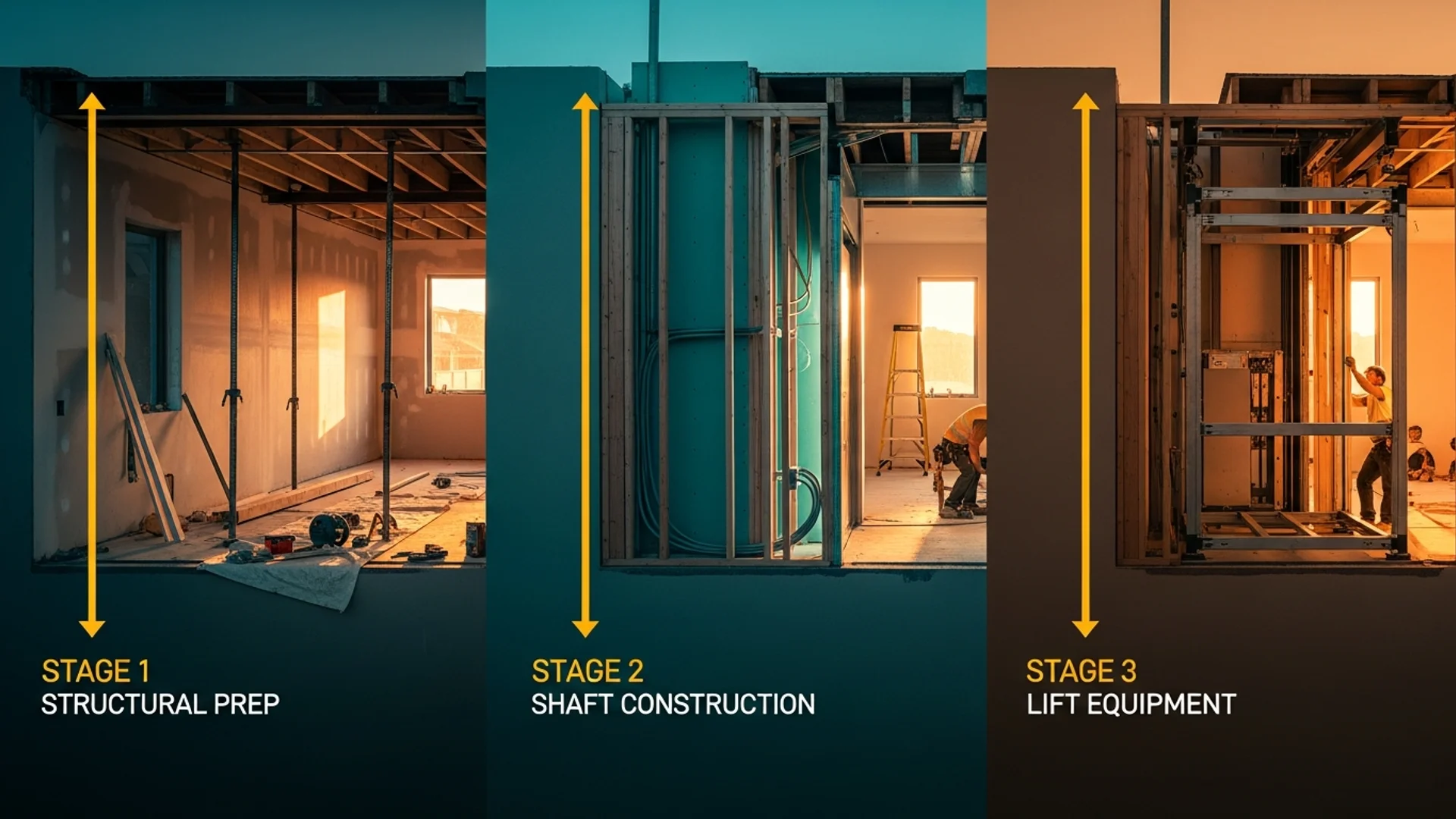
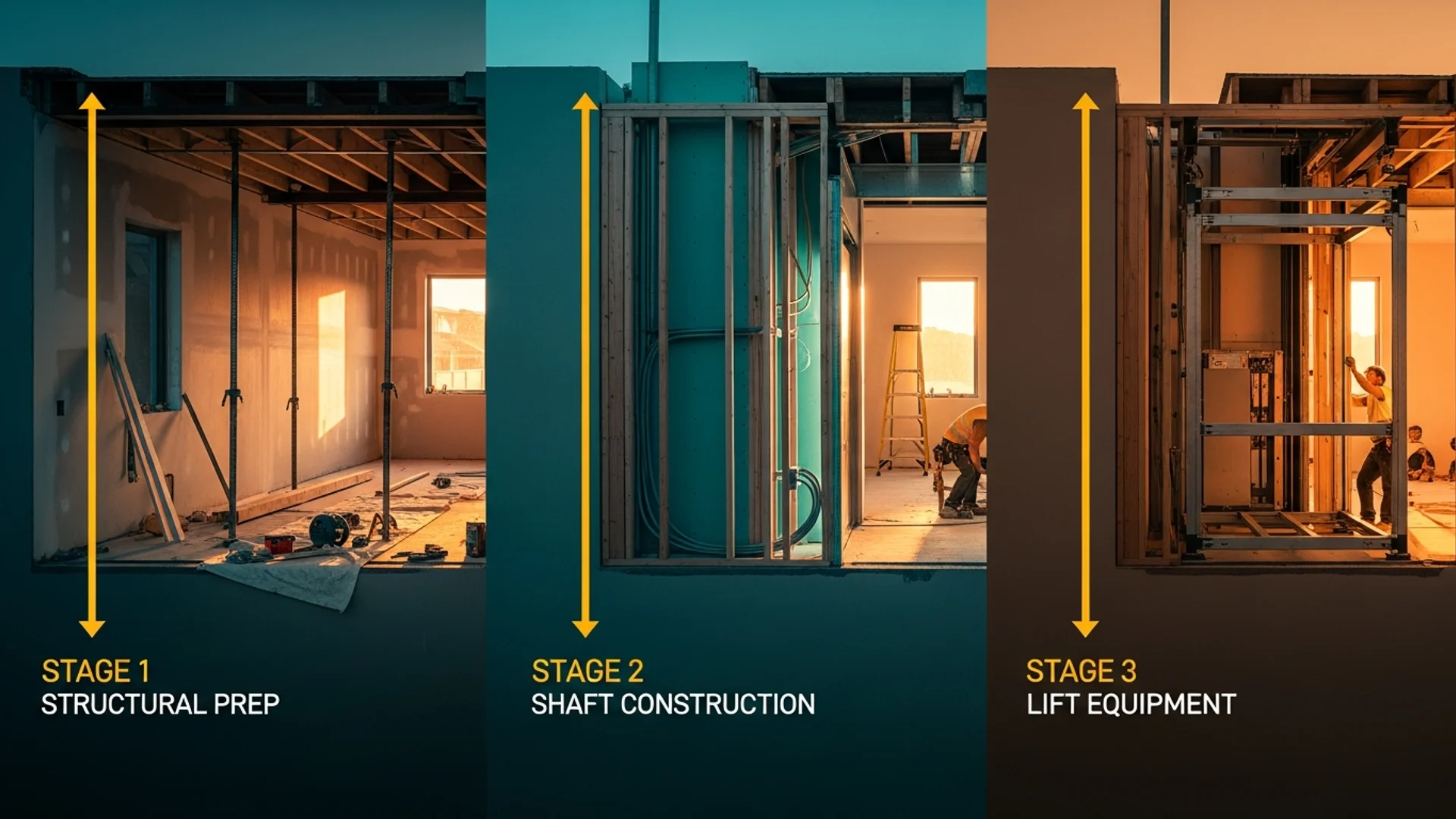
Stage 3 — Building works (1–4 weeks active)
Your builder handles everything the lift needs before it arrives:
- Shaft construction — framing or masonry walls, fire separation where required
- Pit formation — a shallow recess in the slab (50–300mm deep depending on lift type)
- Floor openings — cutting through upper floors for the lift car to pass through
- Power supply — running a dedicated circuit (single-phase 240V for most home lifts; some larger models need three-phase)
- Landing preparation — ensuring each floor level is finished and the door openings are framed
In a new build, these tasks are part of the normal construction programme and add very little time. In a retrofit, the building works are the most disruptive phase. Expect dust, noise, and restricted access to the area for 1–4 weeks depending on scope.
Not every home lift needs a built shaft. Pneumatic vacuum lifts and some screw-drive lifts are self-supporting — they sit on a flat floor with no shaft, pit, or structural modifications. These reduce building works to cutting a circular or rectangular opening in the upper floor only.
Stage 4 — Lift installation (1–5 days)
The lift company delivers and installs the equipment. What happens depends on the lift type:
- Screw-drive or platform lift: Arrives in modular sections. Two installers assemble the frame, install the platform, connect the drive, and wire the controls. Typically 1–2 days.
- Pneumatic vacuum lift: The cylinder sections are stacked in place, the car is inserted, and the vacuum pump is connected. Usually 1 day.
- Hydraulic lift: Guide rails are fixed in the shaft, the car is assembled, the hydraulic power unit is installed (in the shaft or a nearby cupboard), and piping is connected. Usually 2–4 days.
- Electric traction (MRL) lift: Guide rails, car assembly, motor installation at the shaft top, and counterweight fitting. Usually 3–5 days.
During this phase, the lift company works inside the shaft. Disruption to the rest of the home is minimal — mostly noise from drilling and fitting.
Stage 5 — Commissioning and handover (1 day)
The lift installer runs safety tests, adjusts travel limits, checks door interlocks, and verifies emergency features. For lifts covered by AS/NZS 1735.18:2002, the commissioning includes all tests required by the standard.
Once commissioned, you receive operating instructions, a maintenance schedule, and documentation for your building certifier.
Do I need council approval?
In most Australian states, yes. A home lift involves structural work — floor penetrations, a shaft, or a pit — which typically requires a development application (DA) or a complying development certificate (CDC).
The DA process varies by council but generally takes 4–8 weeks. Some homeowners lodge the DA while the lift is being manufactured so the timelines overlap. Your builder or a private certifier can handle the application.
The lift itself must comply with AS/NZS 1735.18:2002 — the Australian Standard for passenger lifts in private residences. Your lift supplier should provide a certificate of compliance at handover.
What the builder does vs what the lift company does
This is where installations stall. The handover between builder and lift supplier needs clear coordination.
Your builder is responsible for:
- Structural works (shaft, pit, floor openings)
- Power supply to the lift location
- Finishes around the shaft and landings
- Obtaining building approval (DA/CDC)
The lift company is responsible for:
- Equipment delivery and crane/logistics if needed
- Mechanical and electrical installation of the lift
- Commissioning and safety testing
- Compliance documentation and certificates
- Ongoing maintenance arrangements
The lift supplier typically provides a builder specification document after the contract is signed. This tells your builder exactly what to prepare — shaft dimensions, pit depth, power requirements, and door opening sizes. Make sure your builder receives this document before starting structural works.
New build vs retrofit timelines
A new build adds almost no time to the construction programme if the lift shaft is designed into the plans. The shaft is formed alongside the rest of the structure, the pit is poured with the slab, and the lift installer arrives during the fitout phase.
New build timeline:
- Building works: integrated into construction (no additional time)
- Manufacturing: 6–12 weeks (runs in parallel with construction)
- Lift installation: 1–5 days
- Total additional project time: effectively zero if coordinated
Retrofit timeline:
- Site assessment and quoting: 1–2 weeks
- DA lodgement and approval: 4–8 weeks (can overlap with manufacturing)
- Manufacturing: 6–12 weeks
- Building works: 1–4 weeks
- Lift installation: 1–5 days
- Total project time: 10–20 weeks from first inquiry to working lift
For what this costs in dollar terms, see home lift costs in Australia.
Common delays and how to avoid them
Three things cause most installation delays:
-
Builder-to-lift-company handover gaps. The builder finishes the shaft but has not run the power supply, or the shaft dimensions are slightly off. Fix: give your builder the lift supplier’s specification document early and have both parties do a joint site check before the lift arrives.
-
DA processing time. Councils vary from 2 to 10 weeks. Fix: lodge the DA as soon as the lift contract is signed, not after.
-
Manufacturing lead times stretching. Supply chain disruptions can push European lift deliveries out by several weeks. Fix: confirm the delivery window in your contract and ask for updates at the 4-week and 8-week marks.
With clear coordination between your builder and lift supplier, and realistic expectations on manufacturing lead times, most home lift installations run smoothly. The disruption is concentrated in the building works phase — and even that is comparable to a kitchen or bathroom renovation in scope.
Lift companies in Australia
Browse profiles, compare service areas, and check reviews.

Shotton Lifts
NDIS★ 5.0 (9 reviews)
Family-owned Australian lift manufacturer since 1977. 80+ staff. Design, engineer, manufacture, install and service from Dandenong South VIC. NDIS registered.
View profile →

LiftFit Australia
NDIS★ 5.0 (8 reviews)
Victoria-based NDIS registered lift provider, est. 2011. Partners with Cibes, Savaria, and Kalea. Residential, commercial, and platform lifts.
View profile →

Easy Living Home Elevators
★ 5.0 (7 reviews)
Australia's #1 home elevator supplier since 1998. 100% Australian-owned. 11,000+ elevators in service across 6 states.
View profile →

EcoLift
★ 5.0 (3 reviews)
Family-owned Sydney lift company. European-parts-based installations for reliability and cost-efficient servicing.
View profile →

Sunshine Coast Elevators
★ 5.0 (3 reviews)
Sunshine Coast QLD specialist in bespoke Italian-made residential elevators and disability access lifts. 38+ years industry experience.
View profile →

EMS Elevator Group
★ 5.0 (2 reviews)
Sydney-based bespoke elevator company specialising in installation, modernisation, and maintenance. 24/7 support.
View profile →
LiftQuotes is a comparison platform. Companies shown are filtered by relevance to this page. Listing does not imply endorsement. LiftQuotes may receive a referral fee when you request quotes.
Put this into action
When you're ready to move forward, get free quotes from verified Australian lift installers.
What are you looking for today?
I need a lift installed
I have a lift that needs attention
The installation stages
A home lift installation follows a predictable sequence regardless of lift type. Understanding each stage helps you plan around disruption and coordinate between your builder and the lift supplier.
Stage 1 — Site assessment and quotation (1–2 weeks)
The lift supplier visits your home to measure the proposed location, assess structural conditions, and confirm which models fit. They need your floor-to-floor height, available footprint, ceiling height, and floor construction type. If you have not already had a structural assessment, they may recommend one before quoting.
For detailed dimension requirements, see our home lift space requirements guide.
Stage 2 — Contract and manufacturing (6–12 weeks)
Once you accept a quote, the lift goes into production. European-manufactured lifts (common in Australia from brands like Cibes, Aritco, and Stannah) typically have 8–12 week lead times. Locally assembled models or simpler platform lifts may arrive in 4–6 weeks.
This is the longest phase — and the best time for your builder to complete the structural works.
Stage 3 — Building works (1–4 weeks active)
Your builder handles everything the lift needs before it arrives:
- Shaft construction — framing or masonry walls, fire separation where required
- Pit formation — a shallow recess in the slab (50–300mm deep depending on lift type)
- Floor openings — cutting through upper floors for the lift car to pass through
- Power supply — running a dedicated circuit (single-phase 240V for most home lifts; some larger models need three-phase)
- Landing preparation — ensuring each floor level is finished and the door openings are framed
In a new build, these tasks are part of the normal construction programme and add very little time. In a retrofit, the building works are the most disruptive phase. Expect dust, noise, and restricted access to the area for 1–4 weeks depending on scope.
Not every home lift needs a built shaft. Pneumatic vacuum lifts and some screw-drive lifts are self-supporting — they sit on a flat floor with no shaft, pit, or structural modifications. These reduce building works to cutting a circular or rectangular opening in the upper floor only.
Stage 4 — Lift installation (1–5 days)
The lift company delivers and installs the equipment. What happens depends on the lift type:
- Screw-drive or platform lift: Arrives in modular sections. Two installers assemble the frame, install the platform, connect the drive, and wire the controls. Typically 1–2 days.
- Pneumatic vacuum lift: The cylinder sections are stacked in place, the car is inserted, and the vacuum pump is connected. Usually 1 day.
- Hydraulic lift: Guide rails are fixed in the shaft, the car is assembled, the hydraulic power unit is installed (in the shaft or a nearby cupboard), and piping is connected. Usually 2–4 days.
- Electric traction (MRL) lift: Guide rails, car assembly, motor installation at the shaft top, and counterweight fitting. Usually 3–5 days.
During this phase, the lift company works inside the shaft. Disruption to the rest of the home is minimal — mostly noise from drilling and fitting.
Stage 5 — Commissioning and handover (1 day)
The lift installer runs safety tests, adjusts travel limits, checks door interlocks, and verifies emergency features. For lifts covered by AS/NZS 1735.18:2002, the commissioning includes all tests required by the standard.
Once commissioned, you receive operating instructions, a maintenance schedule, and documentation for your building certifier.
Do I need council approval?
In most Australian states, yes. A home lift involves structural work — floor penetrations, a shaft, or a pit — which typically requires a development application (DA) or a complying development certificate (CDC).
The DA process varies by council but generally takes 4–8 weeks. Some homeowners lodge the DA while the lift is being manufactured so the timelines overlap. Your builder or a private certifier can handle the application.
The lift itself must comply with AS/NZS 1735.18:2002 — the Australian Standard for passenger lifts in private residences. Your lift supplier should provide a certificate of compliance at handover.
What the builder does vs what the lift company does
This is where installations stall. The handover between builder and lift supplier needs clear coordination.
Your builder is responsible for:
- Structural works (shaft, pit, floor openings)
- Power supply to the lift location
- Finishes around the shaft and landings
- Obtaining building approval (DA/CDC)
The lift company is responsible for:
- Equipment delivery and crane/logistics if needed
- Mechanical and electrical installation of the lift
- Commissioning and safety testing
- Compliance documentation and certificates
- Ongoing maintenance arrangements
The lift supplier typically provides a builder specification document after the contract is signed. This tells your builder exactly what to prepare — shaft dimensions, pit depth, power requirements, and door opening sizes. Make sure your builder receives this document before starting structural works.
New build vs retrofit timelines
A new build adds almost no time to the construction programme if the lift shaft is designed into the plans. The shaft is formed alongside the rest of the structure, the pit is poured with the slab, and the lift installer arrives during the fitout phase.
New build timeline:
- Building works: integrated into construction (no additional time)
- Manufacturing: 6–12 weeks (runs in parallel with construction)
- Lift installation: 1–5 days
- Total additional project time: effectively zero if coordinated
Retrofit timeline:
- Site assessment and quoting: 1–2 weeks
- DA lodgement and approval: 4–8 weeks (can overlap with manufacturing)
- Manufacturing: 6–12 weeks
- Building works: 1–4 weeks
- Lift installation: 1–5 days
- Total project time: 10–20 weeks from first inquiry to working lift
For what this costs in dollar terms, see home lift costs in Australia.
Common delays and how to avoid them
Three things cause most installation delays:
-
Builder-to-lift-company handover gaps. The builder finishes the shaft but has not run the power supply, or the shaft dimensions are slightly off. Fix: give your builder the lift supplier’s specification document early and have both parties do a joint site check before the lift arrives.
-
DA processing time. Councils vary from 2 to 10 weeks. Fix: lodge the DA as soon as the lift contract is signed, not after.
-
Manufacturing lead times stretching. Supply chain disruptions can push European lift deliveries out by several weeks. Fix: confirm the delivery window in your contract and ask for updates at the 4-week and 8-week marks.
With clear coordination between your builder and lift supplier, and realistic expectations on manufacturing lead times, most home lift installations run smoothly. The disruption is concentrated in the building works phase — and even that is comparable to a kitchen or bathroom renovation in scope.
Lift companies in Australia
Browse profiles, compare service areas, and check reviews.
Shotton Lifts
NDIS★ 5.0 (9 reviews)
Family-owned Australian lift manufacturer since 1977. 80+ staff. Design, engineer, manufacture, install and service from Dandenong South VIC. NDIS registered.
View profile →
LiftFit Australia
NDIS★ 5.0 (8 reviews)
Victoria-based NDIS registered lift provider, est. 2011. Partners with Cibes, Savaria, and Kalea. Residential, commercial, and platform lifts.
View profile →
Easy Living Home Elevators
★ 5.0 (7 reviews)
Australia's #1 home elevator supplier since 1998. 100% Australian-owned. 11,000+ elevators in service across 6 states.
View profile →
EcoLift
★ 5.0 (3 reviews)
Family-owned Sydney lift company. European-parts-based installations for reliability and cost-efficient servicing.
View profile →
Sunshine Coast Elevators
★ 5.0 (3 reviews)
Sunshine Coast QLD specialist in bespoke Italian-made residential elevators and disability access lifts. 38+ years industry experience.
View profile →
EMS Elevator Group
★ 5.0 (2 reviews)
Sydney-based bespoke elevator company specialising in installation, modernisation, and maintenance. 24/7 support.
View profile →
LiftQuotes is a comparison platform. Companies shown are filtered by relevance to this page. Listing does not imply endorsement. LiftQuotes may receive a referral fee when you request quotes.
Put this into action
When you're ready to move forward, get free quotes from verified Australian lift installers.
What are you looking for today?
I need a lift installed
I have a lift that needs attention
Lift install: 1–5 days on site
Once the shaft and structural works are complete, the lift equipment arrives and is installed in 1 to 5 days depending on lift type. Pneumatic and screw-drive models are fastest; hydraulic lifts take longer.
Total timeline: 8–16 weeks
From contract signing to a commissioned lift. Manufacturing lead times account for most of this — active building works are typically 1–4 weeks.
Two teams, one project
Your builder handles structural works (shaft, pit, floor openings, power supply). The lift company handles equipment delivery, mechanical installation, and commissioning.
New build vs retrofit
A new build integrates the shaft during construction at minimal extra time. Retrofits add 2–4 weeks of building works before the lift installer arrives.
Home lift installation questions answered
The lift itself is installed in 1 to 5 days once the shaft and structural works are ready. The total project from contract to working lift is typically 8–16 weeks, with most of that time spent on manufacturing and lead times rather than active work in your home.
Related guides
Location
Commercial Lifts Melbourne: Costs, Compliance & Installers
Commercial lift costs, Victorian OHS compliance and the Melbourne installer market — indicative prices, WorkSafe Victoria rules and NCC requirements for VIC projects.
Location
Commercial Lifts Sydney: Costs, Compliance & Installers
Commercial lift costs, NSW compliance and the Sydney installer market — indicative prices, SafeWork NSW rules and NCC requirements for CBD and metro projects.
Guide
What Size Lift Do I Need for a Wheelchair? (Australia)
A home lift for a wheelchair needs roughly 1,100 x 1,400 mm inside and a 900 mm clear door. See minimum sizes for a wheelchair, a carer, and turning space.
Guide
Support at Home & Lift Funding: The 2026 Guide
Can Support at Home fund a home lift or stairlift? How aged care funding works, the OT assessment, means-tested contributions, and how it differs from the NDIS.
Ready to get lift installation quotes?
Share your home details with verified Australian lift installers. Free, no-obligation quotes — compare timelines, costs, and included services.
Join 1,000+ Australians who've requested quotes through LiftQuotes
Get free quotes