
Vacuum (Pneumatic) Lifts in Australia: How They Work & What They Cost
A clear guide to pneumatic vacuum lifts — how the technology works, what they cost installed, and whether one suits your home.
A vacuum lift — also called a pneumatic lift — moves between floors using air pressure instead of cables, hydraulics, or a motor-driven platform. A sealed tube sits over the cabin, and a pump at the top creates a pressure difference that raises or lowers it. No shaft. No pit. No machine room.
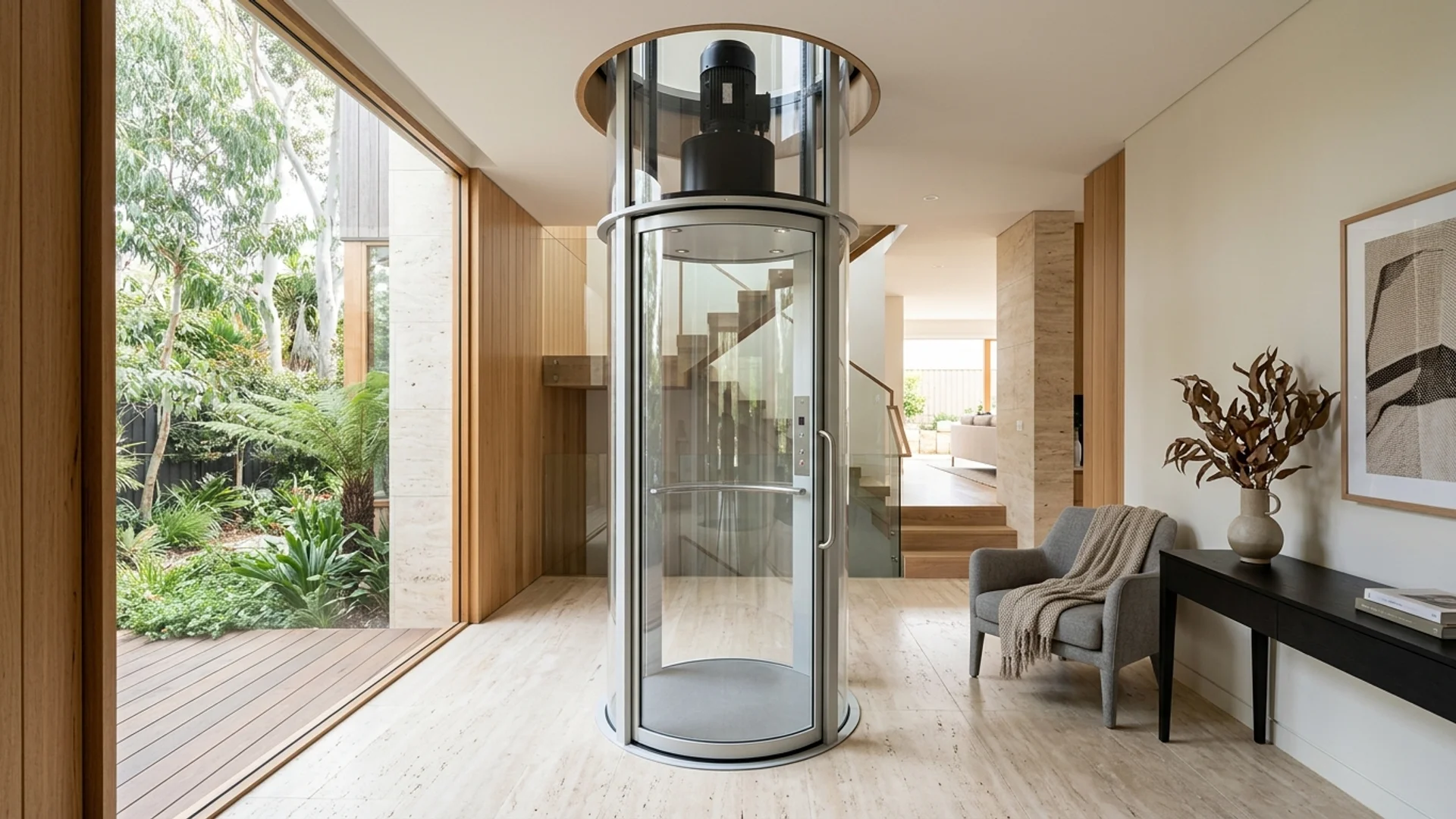
That simplicity is the main draw. A vacuum lift can be installed in a finished home in two to three days, with minimal structural work. The transparent polycarbonate tube doubles as both the structure and the visual feature — most owners treat it as a design element rather than something to hide.
In Australia, vacuum lifts occupy a specific niche: they suit homeowners who need a compact, retrofit-friendly lift for two to four storeys and are comfortable with the trade-offs on speed, capacity, and noise.
How a vacuum lift works
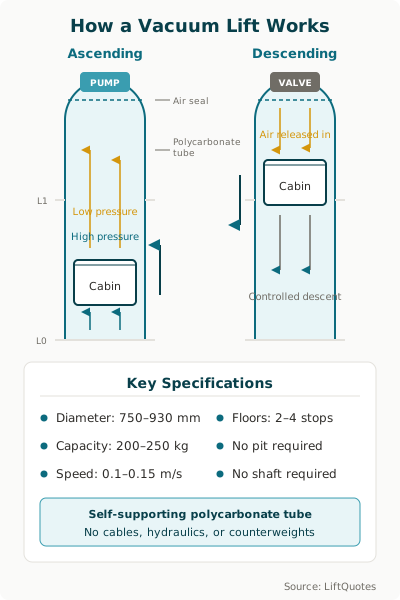
The operating principle is straightforward. A polycarbonate cylinder — typically 750 mm to 930 mm in diameter — extends from the lowest floor to the highest. Inside the cylinder, a cabin moves vertically on guide rails.
To go up, a turbine at the top of the tube extracts air from above the cabin. The higher air pressure below pushes the cabin upward. To come down, air is gradually released back into the upper section, and gravity does the rest. There are no cables, no hydraulic fluid, and no counterweights.
Who should consider a vacuum lift
Vacuum lifts work best for a specific set of circumstances. You are retrofitting a lift into a finished home and want to avoid major structural work. You need to move between two to four floors. You do not need to carry a wheelchair — standard models have a cabin diameter of 750 mm, which is too small for most wheelchairs. And you value the transparent, architectural look.
If you need wheelchair access, a platform lift or a shaft-based home lift is the better option. If you are building new and can plan a shaft into the design, a hydraulic or electric home lift will give you more speed, capacity, and a quieter ride.
What a vacuum lift costs in Australia
As of Q2 2026, expect to pay between $30,000 and $60,000 installed for a residential pneumatic vacuum lift in Australia. The range depends on the number of stops, tube diameter, and the extent of floor-opening preparation required.
The lift equipment itself — tube, cabin, turbine, and controls — accounts for $25,000 to $45,000 of that figure. Building works (floor openings, ceiling penetrations, electrical supply) add $5,000 to $15,000 depending on your home's construction. A single-storey lift in a timber-framed home sits at the lower end. A three-storey install through concrete slabs sits at the upper end.
For a detailed breakdown of home lift pricing across all types, see the home lift cost guide.
Advantages and limitations
The advantages are real. No shaft or pit means less structural disruption and lower building costs. A two-day install timeline is dramatically faster than shaft-based alternatives. The self-supporting tube can be placed almost anywhere you can cut a floor opening — including against an external wall with a view. And if you sell the home, some models can be uninstalled and relocated.
The limitations are equally real. Speed is slow — 0.1 to 0.15 m/s, roughly three to four times slower than a standard home lift. Weight capacity of 200 to 250 kg means one to two adults, no heavy furniture, and no standard wheelchairs. The turbine generates noticeable noise on ascent — not disruptive, but clearly audible in an open-plan living area. And the polycarbonate tube yellows over time with UV exposure, particularly near windows.
For homes where space is the primary constraint, the compact footprint of a vacuum lift is hard to beat. For homes where accessibility, capacity, or speed matter more, a shaft-based lift is the stronger choice.
Standards and compliance
Vacuum lifts installed in Australian homes must comply with AS/NZS 1735.18:2002, the standard covering automatically controlled passenger lifts in private residences. This applies regardless of lift technology — vacuum, hydraulic, or electric.
Your state regulator (SafeWork NSW, WorkSafe Victoria, WHSQ, or equivalent) may require plant design registration. Check with your installer and your state's registrable plant requirements before committing to a purchase.
If you are considering a vacuum lift for your home, get free quotes from Australian lift installers to compare pricing and installation timelines for your specific situation.
Lift companies in Australia
Browse profiles, compare service areas, and check reviews.

Shotton Lifts
NDIS★ 5.0 (9 reviews)
Family-owned Australian lift manufacturer since 1977. 80+ staff. Design, engineer, manufacture, install and service from Dandenong South VIC. NDIS registered.
View profile →

LiftFit Australia
NDIS★ 5.0 (8 reviews)
Victoria-based NDIS registered lift provider, est. 2011. Partners with Cibes, Savaria, and Kalea. Residential, commercial, and platform lifts.
View profile →

Easy Living Home Elevators
★ 5.0 (7 reviews)
Australia's #1 home elevator supplier since 1998. 100% Australian-owned. 11,000+ elevators in service across 6 states.
View profile →

EcoLift
★ 5.0 (3 reviews)
Family-owned Sydney lift company. European-parts-based installations for reliability and cost-efficient servicing.
View profile →

Sunshine Coast Elevators
★ 5.0 (3 reviews)
Sunshine Coast QLD specialist in bespoke Italian-made residential elevators and disability access lifts. 38+ years industry experience.
View profile →

EMS Elevator Group
★ 5.0 (2 reviews)
Sydney-based bespoke elevator company specialising in installation, modernisation, and maintenance. 24/7 support.
View profile →
LiftQuotes is a comparison platform. Companies shown are filtered by relevance to this page. Listing does not imply endorsement. LiftQuotes may receive a referral fee when you request quotes.
Vacuum lift pricing in Australia depends on the number of stops, cabin diameter, and the structural work needed to create floor openings.
| Scenario | Cost range (AUD, ex GST) | Notes |
|---|---|---|
| Single-stop vacuum lift (2 floors), 750 mm tube, timber-frame home | $30,000–$40,000 | Entry-level configuration. Includes standard cabin, turbine, and controls. Building works for one floor opening in timber construction. |
| Two-stop vacuum lift (3 floors), 870 mm tube | $40,000–$50,000 | Mid-range. Larger cabin diameter for more comfortable ride. Two floor openings required. |
| Three-stop vacuum lift (4 floors), 930 mm tube, concrete slab construction | $50,000–$60,000 | Upper range. Largest available cabin size. Three floor penetrations through concrete slabs increase building works cost significantly. |
Ranges are indicative, ex GST, based on published supplier pricing and Australian installer quotes compiled by LiftQuotes. Actual costs vary by site conditions, access, and location. Regional and remote areas may incur additional transport and labour costs.
Last checked: 1 April 2026
Put this into action
When you're ready to move forward, get free quotes from verified Australian lift installers.
What are you looking for today?
I need a lift installed
I have a lift that needs attention
A vacuum lift — also called a pneumatic lift — moves between floors using air pressure instead of cables, hydraulics, or a motor-driven platform. A sealed tube sits over the cabin, and a pump at the top creates a pressure difference that raises or lowers it. No shaft. No pit. No machine room.
That simplicity is the main draw. A vacuum lift can be installed in a finished home in two to three days, with minimal structural work. The transparent polycarbonate tube doubles as both the structure and the visual feature — most owners treat it as a design element rather than something to hide.
In Australia, vacuum lifts occupy a specific niche: they suit homeowners who need a compact, retrofit-friendly lift for two to four storeys and are comfortable with the trade-offs on speed, capacity, and noise.
How a vacuum lift works
The operating principle is straightforward. A polycarbonate cylinder — typically 750 mm to 930 mm in diameter — extends from the lowest floor to the highest. Inside the cylinder, a cabin moves vertically on guide rails.
To go up, a turbine at the top of the tube extracts air from above the cabin. The higher air pressure below pushes the cabin upward. To come down, air is gradually released back into the upper section, and gravity does the rest. There are no cables, no hydraulic fluid, and no counterweights.
Who should consider a vacuum lift
Vacuum lifts work best for a specific set of circumstances. You are retrofitting a lift into a finished home and want to avoid major structural work. You need to move between two to four floors. You do not need to carry a wheelchair — standard models have a cabin diameter of 750 mm, which is too small for most wheelchairs. And you value the transparent, architectural look.
If you need wheelchair access, a platform lift or a shaft-based home lift is the better option. If you are building new and can plan a shaft into the design, a hydraulic or electric home lift will give you more speed, capacity, and a quieter ride.
What a vacuum lift costs in Australia
As of Q2 2026, expect to pay between $30,000 and $60,000 installed for a residential pneumatic vacuum lift in Australia. The range depends on the number of stops, tube diameter, and the extent of floor-opening preparation required.
The lift equipment itself — tube, cabin, turbine, and controls — accounts for $25,000 to $45,000 of that figure. Building works (floor openings, ceiling penetrations, electrical supply) add $5,000 to $15,000 depending on your home's construction. A single-storey lift in a timber-framed home sits at the lower end. A three-storey install through concrete slabs sits at the upper end.
For a detailed breakdown of home lift pricing across all types, see the home lift cost guide.
Advantages and limitations
The advantages are real. No shaft or pit means less structural disruption and lower building costs. A two-day install timeline is dramatically faster than shaft-based alternatives. The self-supporting tube can be placed almost anywhere you can cut a floor opening — including against an external wall with a view. And if you sell the home, some models can be uninstalled and relocated.
The limitations are equally real. Speed is slow — 0.1 to 0.15 m/s, roughly three to four times slower than a standard home lift. Weight capacity of 200 to 250 kg means one to two adults, no heavy furniture, and no standard wheelchairs. The turbine generates noticeable noise on ascent — not disruptive, but clearly audible in an open-plan living area. And the polycarbonate tube yellows over time with UV exposure, particularly near windows.
For homes where space is the primary constraint, the compact footprint of a vacuum lift is hard to beat. For homes where accessibility, capacity, or speed matter more, a shaft-based lift is the stronger choice.
Standards and compliance
Vacuum lifts installed in Australian homes must comply with AS/NZS 1735.18:2002, the standard covering automatically controlled passenger lifts in private residences. This applies regardless of lift technology — vacuum, hydraulic, or electric.
Your state regulator (SafeWork NSW, WorkSafe Victoria, WHSQ, or equivalent) may require plant design registration. Check with your installer and your state's registrable plant requirements before committing to a purchase.
If you are considering a vacuum lift for your home, get free quotes from Australian lift installers to compare pricing and installation timelines for your specific situation.
Lift companies in Australia
Browse profiles, compare service areas, and check reviews.
Shotton Lifts
NDIS★ 5.0 (9 reviews)
Family-owned Australian lift manufacturer since 1977. 80+ staff. Design, engineer, manufacture, install and service from Dandenong South VIC. NDIS registered.
View profile →
LiftFit Australia
NDIS★ 5.0 (8 reviews)
Victoria-based NDIS registered lift provider, est. 2011. Partners with Cibes, Savaria, and Kalea. Residential, commercial, and platform lifts.
View profile →
Easy Living Home Elevators
★ 5.0 (7 reviews)
Australia's #1 home elevator supplier since 1998. 100% Australian-owned. 11,000+ elevators in service across 6 states.
View profile →
EcoLift
★ 5.0 (3 reviews)
Family-owned Sydney lift company. European-parts-based installations for reliability and cost-efficient servicing.
View profile →
Sunshine Coast Elevators
★ 5.0 (3 reviews)
Sunshine Coast QLD specialist in bespoke Italian-made residential elevators and disability access lifts. 38+ years industry experience.
View profile →
EMS Elevator Group
★ 5.0 (2 reviews)
Sydney-based bespoke elevator company specialising in installation, modernisation, and maintenance. 24/7 support.
View profile →
LiftQuotes is a comparison platform. Companies shown are filtered by relevance to this page. Listing does not imply endorsement. LiftQuotes may receive a referral fee when you request quotes.
Vacuum lift pricing in Australia depends on the number of stops, cabin diameter, and the structural work needed to create floor openings.
| Scenario | Cost range (AUD, ex GST) | Notes |
|---|---|---|
| Single-stop vacuum lift (2 floors), 750 mm tube, timber-frame home | $30,000–$40,000 | Entry-level configuration. Includes standard cabin, turbine, and controls. Building works for one floor opening in timber construction. |
| Two-stop vacuum lift (3 floors), 870 mm tube | $40,000–$50,000 | Mid-range. Larger cabin diameter for more comfortable ride. Two floor openings required. |
| Three-stop vacuum lift (4 floors), 930 mm tube, concrete slab construction | $50,000–$60,000 | Upper range. Largest available cabin size. Three floor penetrations through concrete slabs increase building works cost significantly. |
Ranges are indicative, ex GST, based on published supplier pricing and Australian installer quotes compiled by LiftQuotes. Actual costs vary by site conditions, access, and location. Regional and remote areas may incur additional transport and labour costs.
Last checked: 1 April 2026
Put this into action
When you're ready to move forward, get free quotes from verified Australian lift installers.
What are you looking for today?
I need a lift installed
I have a lift that needs attention
No shaft or pit required
The polycarbonate tube is self-supporting. You need a floor opening between levels and a ceiling cutout — but no concrete shaft, no excavated pit, and no dedicated machine room.
Fast installation
Most residential installs take two to three days once the floor opening is prepared. Compare that to four to eight weeks for a shaft-based home lift.
Small footprint
External tube diameter ranges from 750 mm to 930 mm. The smallest models take up less floor space than a wardrobe.
Limited capacity
Weight capacity tops out at 200–250 kg — enough for one to two passengers but not wheelchair-friendly in standard configurations. Speed is 0.1–0.15 m/s.
Common questions about vacuum lifts
A vacuum lift uses air pressure to move a cabin inside a sealed polycarbonate tube. A turbine at the top extracts air from above the cabin, creating a pressure difference that pushes it upward. To descend, air is released back into the tube and gravity lowers the cabin in a controlled manner. There are no cables, hydraulic fluid, or counterweights.
Related guides
Location
Commercial Lifts Melbourne: Costs, Compliance & Installers
Commercial lift costs, Victorian OHS compliance and the Melbourne installer market — indicative prices, WorkSafe Victoria rules and NCC requirements for VIC projects.
Location
Commercial Lifts Sydney: Costs, Compliance & Installers
Commercial lift costs, NSW compliance and the Sydney installer market — indicative prices, SafeWork NSW rules and NCC requirements for CBD and metro projects.
Guide
What Size Lift Do I Need for a Wheelchair? (Australia)
A home lift for a wheelchair needs roughly 1,100 x 1,400 mm inside and a 900 mm clear door. See minimum sizes for a wheelchair, a carer, and turning space.
Guide
Support at Home & Lift Funding: The 2026 Guide
Can Support at Home fund a home lift or stairlift? How aged care funding works, the OT assessment, means-tested contributions, and how it differs from the NDIS.
Ready to explore vacuum lifts for your home?
Compare quotes from Australian vacuum lift installers. Tell us about your home and we will connect you with suppliers who can assess your site and provide accurate pricing.
Join 1,000+ Australians who've requested quotes through LiftQuotes
Get free quotes