How Much Does a Lift Cost in Australia?
Indicative 2026 cost ranges for every lift type — home, platform, commercial, stairlift, and wheelchair. All figures ex GST, sourced and dated.
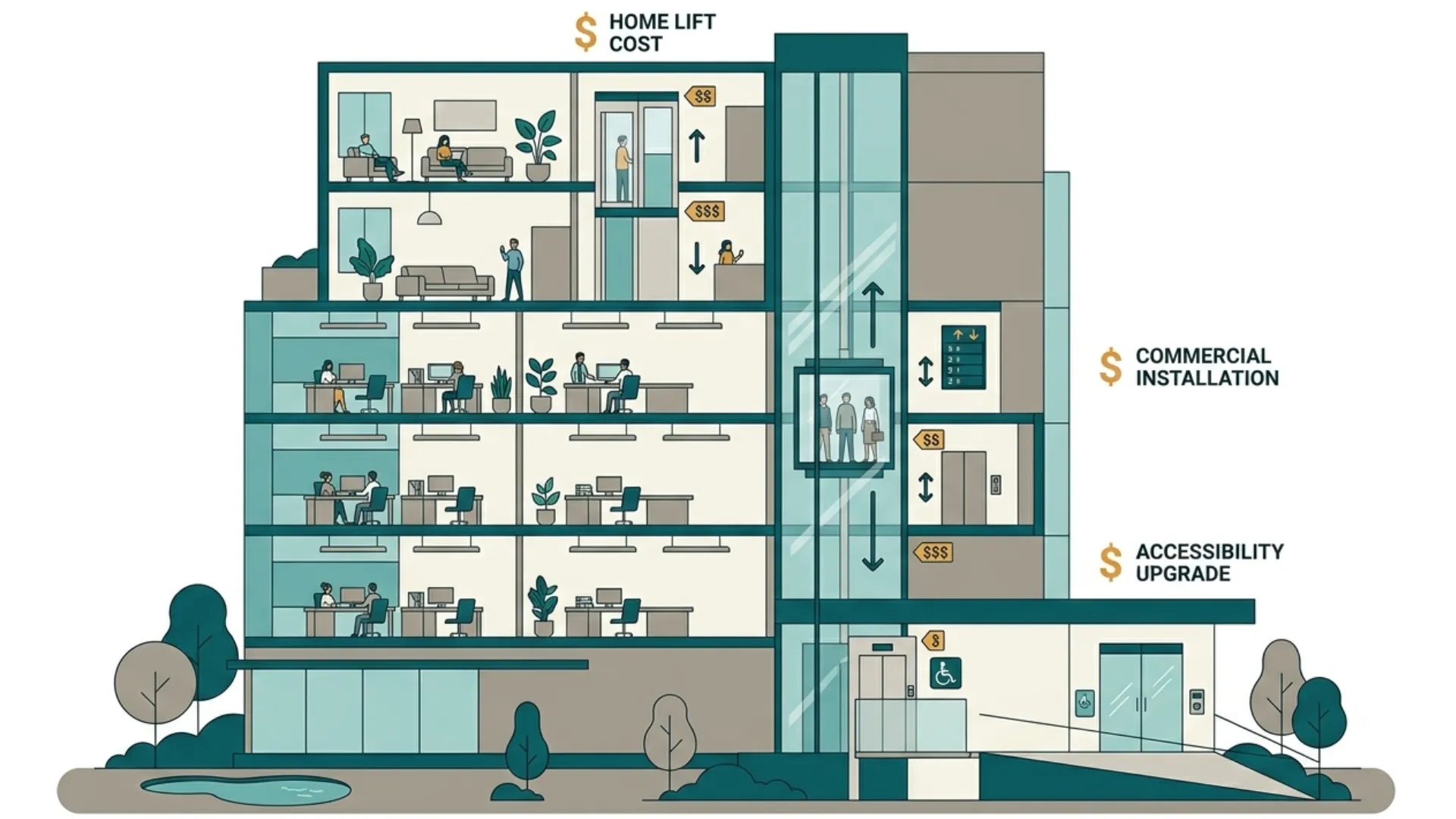
A home lift in Australia typically costs between $20,000 and $70,000 installed. A platform lift for wheelchair access starts from around $22,000. A commercial passenger lift in a mid-rise building can run from $50,000 to well over $200,000. The ranges are wide because every installation is shaped by site-specific factors — the number of stops, whether the building is new or existing, and how much structural work the shaft and pit require.
This page brings together indicative cost data for every major lift category available in Australia: home lifts, platform lifts, commercial passenger lifts, stairlifts, and wheelchair lifts. Each range is sourced from published cost guides and supplier-stated pricing, with caveats noted. Figures are ex GST and typically exclude building works unless stated otherwise.
These numbers are a starting point. The only way to get a figure specific to your project is to request quotes from installers who can assess your site. Use the ranges below to calibrate your expectations before that conversation.
Indicative cost ranges by lift type
The table below shows indicative installed cost ranges for the five main lift categories in Australia. All figures are ex GST. Building works — shaft construction, concrete pit, structural floor modifications, and electrical supply — are additional unless noted.
| Scenario | Cost range (AUD, ex GST) | Notes |
|---|---|---|
| Home lift — 2-stop, standard shaft, new build | $20,000–$70,000 | Entry-level compact through-floor lifts sit near $20K. Hydraulic or MRL lifts with full shaft and pit in a retrofit approach the upper end. Source: hipages national cost guide and supplier-stated starting prices; last checked March 2026. |
| Platform lift — low-rise wheelchair access, indoor | $22,000–$45,000 | Enclosed vertical platform lifts for wheelchair access over 1–2 levels. Open platform lifts for single-step access start lower. Outdoor and weather-rated models cost more. Source: supplier-stated pricing, Australian market; last checked March 2026. |
| Commercial passenger lift — 2–6 stops, mid-rise | $50,000–$200,000 | Traction or MRL passenger lifts for commercial buildings. Price varies with travel height, car size, speed, and NCC compliance scope. Hospital/stretcher lifts exceed this range. Source: supplier-stated commercial pricing; last checked March 2026. |
| Stairlift — straight staircase, single flight | $5,000–$15,000 | Straight-rail stairlifts for a single flight. Curved staircases require custom rails and cost $10,000–$25,000. Source: hipages and supplier pricing; last checked March 2026. |
| Wheelchair lift — vertical platform, residential | $15,000–$35,000 | Vertical platform lifts for wheelchair access, typically 1–2 stops. NDIS or Support at Home funding may cover part of the cost for eligible participants. Source: supplier-stated pricing; last checked March 2026. |
All ranges are indicative and based on published cost guides (hipages) and supplier-stated starting prices from major Australian distributors. Figures are ex GST and exclude building works unless stated. Actual project costs depend on site conditions, structural scope, and installer pricing.
Last checked: 25 March 2026
What drives the cost up or down
The range between the lowest and highest figure for any lift type is driven by a small number of factors. Understanding these before you request quotes will help you compare proposals on a like-for-like basis.
Building works and structural scope
This is the single biggest variable. A lift installed during a new build — where the shaft, pit, and structural openings are designed into the plans — costs significantly less than a retrofit into an existing building. Retrofitting a shaft into an older home can add $5,000–$20,000 or more to the base equipment price. In commercial buildings, the structural scope is typically larger and more expensive.
Number of stops and travel height
A 2-stop home lift is the baseline configuration. Each additional stop adds cost — both for the lift equipment (additional landing doors, controls, and guide rails) and for the building works (additional structural openings). Commercial lifts serving 6+ stops cost substantially more than a 2-stop installation.
Lift type and drive system
Hydraulic, traction, pneumatic, and platform lifts have different equipment cost profiles. Pneumatic lifts avoid shaft construction costs but have a higher unit price. Traction lifts are the standard for commercial applications. The drive system also affects ongoing energy and maintenance costs.
Finishes and car configuration
Standard finishes — painted steel, laminate panels, basic lighting — sit at the lower end. Glass panels, stainless steel, custom timber, and through-car (front-and-rear door) configurations increase the price. In a home, premium finishes can add $5,000–$15,000 over a standard fit-out.
Compliance and site access
NCC requirements, DDA compliance scope, and state-specific plant registration obligations add cost in commercial and multi-residential projects. Difficult site access — narrow doorways, heritage constraints, upper-floor crane lifts — can increase building works cost significantly.
Lift companies in Australia
Browse profiles, compare service areas, and check reviews.

Lift Shop
★ 5.0 (1551 reviews)
Australia's largest dedicated home lift specialist since 1996. 10,000+ installations. Exclusive Italian-crafted lifts with industry-leading 8-year warranty.
View profile →

Compact Home Lifts
NDIS★ 5.0 (465 reviews)
Melbourne branch of Compact Home Lifts. Compact residential lift specialist providing maintenance and repair services across Victoria.
View profile →

Next Level Elevators
★ 5.0 (454 reviews)
Award-winning provider of premium Italian-designed all-electric home elevators. Certified Eltec Partner. Showrooms in Melbourne, Sydney, and Brisbane.
View profile →

Shotton Lifts
NDIS★ 5.0 (9 reviews)
Family-owned Australian lift manufacturer since 1977. 80+ staff. Design, engineer, manufacture, install and service from Dandenong South VIC. NDIS registered.
View profile →

LiftFit Australia
NDIS★ 5.0 (8 reviews)
Victoria-based NDIS registered lift provider, est. 2011. Partners with Cibes, Savaria, and Kalea. Residential, commercial, and platform lifts.
View profile →

Easy Living Home Elevators
★ 5.0 (7 reviews)
Australia's #1 home elevator supplier since 1998. 100% Australian-owned. 11,000+ elevators in service across 6 states.
View profile →
LiftQuotes is a comparison platform. Companies shown are filtered by relevance to this page. Listing does not imply endorsement. LiftQuotes may receive a referral fee when you request quotes.
What is typically not included in a lift quote
What is typically not included in a lift quote
Supplier-stated starting prices and published cost guides typically cover the lift equipment and installation labour. The following items are commonly excluded or quoted separately — and they are often the largest variable in the total project cost:
- Shaft construction — structural walls, framing, or enclosure for the lift well
- Concrete pit — the recessed pit below the lowest landing required by most lift types (except pneumatic lifts)
- Structural floor modifications — cutting or reinforcing floor openings at each landing
- Electrical supply — a dedicated circuit from the switchboard to the lift, including any switchboard upgrades
- Builder or certifier fees — building surveyor sign-off, engineering certification, and development application costs
- Finishes — painting, plastering, or cladding around the shaft opening at each landing
- Crane hire — if the lift or shaft components need to be lifted to an upper floor or over a structure
When comparing quotes, ask each installer to itemise building works separately from the lift equipment and installation. A quote that includes building works is not directly comparable to one that excludes them.
Ongoing costs after installation
The purchase price is the largest cost, but ongoing costs matter over the life of the lift:
- Annual servicing: $500–$1,500 per year for residential lifts; $2,000–$6,000+ for commercial lifts, depending on contract scope (indicative; last checked March 2026)
- Energy: Most home lifts draw 2–5 kW and operate infrequently — annual electricity cost is typically under $100. Commercial lifts in high-traffic buildings cost more.
- Insurance: Your home or building insurance should cover the lift as a fixture. Confirm with your insurer that the installation is noted on the policy.
- Plant registration renewal: Some states require periodic registration renewal for registrable plant. Check with your state WHS regulator.
How to use these ranges
These figures are for calibration, not budgeting. They help you understand the order of magnitude before you engage with installers. The only reliable cost figure for your project comes from a site-specific quote — an installer who has seen your site, understands the structural scope, and can price the full project including building works.
For detailed cost breakdowns by category, see the dedicated cost pages: home lift costs, wheelchair lift costs, commercial lift costs, and lift maintenance costs. For category overviews, types, and compliance context, see home lifts, platform lifts, commercial lifts, and lift maintenance.
How these figures were sourced
Cost ranges on this page are compiled from three source types: published consumer cost guides (hipages national cost guide), supplier-stated starting prices from major Australian lift distributors, and indicative contract pricing from Australian lift service providers. All figures are indicative. They represent the range of prices available in the Australian market for standard configurations. Actual project costs depend on your site, structural scope, and the installer you engage. LiftQuotes does not set or guarantee pricing — we compile and present available market data to help buyers calibrate expectations. Where a figure comes from a supplier-stated starting price, we note that it typically excludes building works and may not include GST. Where a figure comes from a published cost guide, we cite the publisher and note the date of last verification.
Sources: hipages national cost guide (home lifts, stairlifts); supplier-stated pricing from major Australian residential, platform, commercial, and wheelchair lift distributors; supplier-stated service contract pricing from Australian lift service providers.
Last reviewed
25 March 2026
Next review due
25 September 2026
Get quotes tailored to your project
Tell us about your home and receive personalised pricing from local installers.
What are you looking for today?
I need a lift installed
I have a lift that needs attention
A home lift in Australia typically costs between $20,000 and $70,000 installed. A platform lift for wheelchair access starts from around $22,000. A commercial passenger lift in a mid-rise building can run from $50,000 to well over $200,000. The ranges are wide because every installation is shaped by site-specific factors — the number of stops, whether the building is new or existing, and how much structural work the shaft and pit require.
This page brings together indicative cost data for every major lift category available in Australia: home lifts, platform lifts, commercial passenger lifts, stairlifts, and wheelchair lifts. Each range is sourced from published cost guides and supplier-stated pricing, with caveats noted. Figures are ex GST and typically exclude building works unless stated otherwise.
These numbers are a starting point. The only way to get a figure specific to your project is to request quotes from installers who can assess your site. Use the ranges below to calibrate your expectations before that conversation.
Indicative cost ranges by lift type
The table below shows indicative installed cost ranges for the five main lift categories in Australia. All figures are ex GST. Building works — shaft construction, concrete pit, structural floor modifications, and electrical supply — are additional unless noted.
| Scenario | Cost range (AUD, ex GST) | Notes |
|---|---|---|
| Home lift — 2-stop, standard shaft, new build | $20,000–$70,000 | Entry-level compact through-floor lifts sit near $20K. Hydraulic or MRL lifts with full shaft and pit in a retrofit approach the upper end. Source: hipages national cost guide and supplier-stated starting prices; last checked March 2026. |
| Platform lift — low-rise wheelchair access, indoor | $22,000–$45,000 | Enclosed vertical platform lifts for wheelchair access over 1–2 levels. Open platform lifts for single-step access start lower. Outdoor and weather-rated models cost more. Source: supplier-stated pricing, Australian market; last checked March 2026. |
| Commercial passenger lift — 2–6 stops, mid-rise | $50,000–$200,000 | Traction or MRL passenger lifts for commercial buildings. Price varies with travel height, car size, speed, and NCC compliance scope. Hospital/stretcher lifts exceed this range. Source: supplier-stated commercial pricing; last checked March 2026. |
| Stairlift — straight staircase, single flight | $5,000–$15,000 | Straight-rail stairlifts for a single flight. Curved staircases require custom rails and cost $10,000–$25,000. Source: hipages and supplier pricing; last checked March 2026. |
| Wheelchair lift — vertical platform, residential | $15,000–$35,000 | Vertical platform lifts for wheelchair access, typically 1–2 stops. NDIS or Support at Home funding may cover part of the cost for eligible participants. Source: supplier-stated pricing; last checked March 2026. |
All ranges are indicative and based on published cost guides (hipages) and supplier-stated starting prices from major Australian distributors. Figures are ex GST and exclude building works unless stated. Actual project costs depend on site conditions, structural scope, and installer pricing.
Last checked: 25 March 2026
What drives the cost up or down
The range between the lowest and highest figure for any lift type is driven by a small number of factors. Understanding these before you request quotes will help you compare proposals on a like-for-like basis.
Building works and structural scope
This is the single biggest variable. A lift installed during a new build — where the shaft, pit, and structural openings are designed into the plans — costs significantly less than a retrofit into an existing building. Retrofitting a shaft into an older home can add $5,000–$20,000 or more to the base equipment price. In commercial buildings, the structural scope is typically larger and more expensive.
Number of stops and travel height
A 2-stop home lift is the baseline configuration. Each additional stop adds cost — both for the lift equipment (additional landing doors, controls, and guide rails) and for the building works (additional structural openings). Commercial lifts serving 6+ stops cost substantially more than a 2-stop installation.
Lift type and drive system
Hydraulic, traction, pneumatic, and platform lifts have different equipment cost profiles. Pneumatic lifts avoid shaft construction costs but have a higher unit price. Traction lifts are the standard for commercial applications. The drive system also affects ongoing energy and maintenance costs.
Finishes and car configuration
Standard finishes — painted steel, laminate panels, basic lighting — sit at the lower end. Glass panels, stainless steel, custom timber, and through-car (front-and-rear door) configurations increase the price. In a home, premium finishes can add $5,000–$15,000 over a standard fit-out.
Compliance and site access
NCC requirements, DDA compliance scope, and state-specific plant registration obligations add cost in commercial and multi-residential projects. Difficult site access — narrow doorways, heritage constraints, upper-floor crane lifts — can increase building works cost significantly.
Lift companies in Australia
Browse profiles, compare service areas, and check reviews.
Lift Shop
★ 5.0 (1551 reviews)
Australia's largest dedicated home lift specialist since 1996. 10,000+ installations. Exclusive Italian-crafted lifts with industry-leading 8-year warranty.
View profile →
Compact Home Lifts
NDIS★ 5.0 (465 reviews)
Melbourne branch of Compact Home Lifts. Compact residential lift specialist providing maintenance and repair services across Victoria.
View profile →
Next Level Elevators
★ 5.0 (454 reviews)
Award-winning provider of premium Italian-designed all-electric home elevators. Certified Eltec Partner. Showrooms in Melbourne, Sydney, and Brisbane.
View profile →
Shotton Lifts
NDIS★ 5.0 (9 reviews)
Family-owned Australian lift manufacturer since 1977. 80+ staff. Design, engineer, manufacture, install and service from Dandenong South VIC. NDIS registered.
View profile →
LiftFit Australia
NDIS★ 5.0 (8 reviews)
Victoria-based NDIS registered lift provider, est. 2011. Partners with Cibes, Savaria, and Kalea. Residential, commercial, and platform lifts.
View profile →
Easy Living Home Elevators
★ 5.0 (7 reviews)
Australia's #1 home elevator supplier since 1998. 100% Australian-owned. 11,000+ elevators in service across 6 states.
View profile →
LiftQuotes is a comparison platform. Companies shown are filtered by relevance to this page. Listing does not imply endorsement. LiftQuotes may receive a referral fee when you request quotes.
What is typically not included in a lift quote
What is typically not included in a lift quote
Supplier-stated starting prices and published cost guides typically cover the lift equipment and installation labour. The following items are commonly excluded or quoted separately — and they are often the largest variable in the total project cost:
- Shaft construction — structural walls, framing, or enclosure for the lift well
- Concrete pit — the recessed pit below the lowest landing required by most lift types (except pneumatic lifts)
- Structural floor modifications — cutting or reinforcing floor openings at each landing
- Electrical supply — a dedicated circuit from the switchboard to the lift, including any switchboard upgrades
- Builder or certifier fees — building surveyor sign-off, engineering certification, and development application costs
- Finishes — painting, plastering, or cladding around the shaft opening at each landing
- Crane hire — if the lift or shaft components need to be lifted to an upper floor or over a structure
When comparing quotes, ask each installer to itemise building works separately from the lift equipment and installation. A quote that includes building works is not directly comparable to one that excludes them.
Ongoing costs after installation
The purchase price is the largest cost, but ongoing costs matter over the life of the lift:
- Annual servicing: $500–$1,500 per year for residential lifts; $2,000–$6,000+ for commercial lifts, depending on contract scope (indicative; last checked March 2026)
- Energy: Most home lifts draw 2–5 kW and operate infrequently — annual electricity cost is typically under $100. Commercial lifts in high-traffic buildings cost more.
- Insurance: Your home or building insurance should cover the lift as a fixture. Confirm with your insurer that the installation is noted on the policy.
- Plant registration renewal: Some states require periodic registration renewal for registrable plant. Check with your state WHS regulator.
How to use these ranges
These figures are for calibration, not budgeting. They help you understand the order of magnitude before you engage with installers. The only reliable cost figure for your project comes from a site-specific quote — an installer who has seen your site, understands the structural scope, and can price the full project including building works.
For detailed cost breakdowns by category, see the dedicated cost pages: home lift costs, wheelchair lift costs, commercial lift costs, and lift maintenance costs. For category overviews, types, and compliance context, see home lifts, platform lifts, commercial lifts, and lift maintenance.
How these figures were sourced
Cost ranges on this page are compiled from three source types: published consumer cost guides (hipages national cost guide), supplier-stated starting prices from major Australian lift distributors, and indicative contract pricing from Australian lift service providers. All figures are indicative. They represent the range of prices available in the Australian market for standard configurations. Actual project costs depend on your site, structural scope, and the installer you engage. LiftQuotes does not set or guarantee pricing — we compile and present available market data to help buyers calibrate expectations. Where a figure comes from a supplier-stated starting price, we note that it typically excludes building works and may not include GST. Where a figure comes from a published cost guide, we cite the publisher and note the date of last verification.
Sources: hipages national cost guide (home lifts, stairlifts); supplier-stated pricing from major Australian residential, platform, commercial, and wheelchair lift distributors; supplier-stated service contract pricing from Australian lift service providers.
Last reviewed
25 March 2026
Next review due
25 September 2026
Get quotes tailored to your project
Tell us about your home and receive personalised pricing from local installers.
What are you looking for today?
I need a lift installed
I have a lift that needs attention
Frequently asked questions about lift costs
There is no single average — costs vary by lift type and project scope. Indicative installed ranges for standard configurations: home lifts $20,000–$70,000, platform lifts $22,000–$45,000, commercial passenger lifts $50,000–$200,000+, stairlifts $5,000–$15,000, and wheelchair lifts $15,000–$35,000. All figures are ex GST and typically exclude building works. The most useful figure for your project comes from a site-specific quote, not an average.
Related guides
Location
Commercial Lifts Melbourne: Costs, Compliance & Installers
Commercial lift costs, Victorian OHS compliance and the Melbourne installer market — indicative prices, WorkSafe Victoria rules and NCC requirements for VIC projects.
Location
Commercial Lifts Sydney: Costs, Compliance & Installers
Commercial lift costs, NSW compliance and the Sydney installer market — indicative prices, SafeWork NSW rules and NCC requirements for CBD and metro projects.
Guide
What Size Lift Do I Need for a Wheelchair? (Australia)
A home lift for a wheelchair needs roughly 1,100 x 1,400 mm inside and a 900 mm clear door. See minimum sizes for a wheelchair, a carer, and turning space.
Guide
Support at Home & Lift Funding: The 2026 Guide
Can Support at Home fund a home lift or stairlift? How aged care funding works, the OT assessment, means-tested contributions, and how it differs from the NDIS.
Get a cost estimate specific to your project
The ranges above are indicative. Your project cost depends on your site, structural scope, and the installer you choose. Get free, no-obligation quotes from verified Australian lift installers.
Join 1,000+ Australians who've requested quotes through LiftQuotes
Get free quotes