
DDA Lift Compliance: What Australian Building Owners Must Know
When a lift is required under the Premises Standards, what the DDA mandates for car dimensions, doors, controls, and indicators — and when the unjustifiable hardship defence applies.
The Disability Discrimination Act 1992 (DDA) and the Disability (Access to Premises — Buildings) Standards 2010 (the Premises Standards) establish when a building must provide lift access and what that lift must deliver. For building owners, the obligation is specific: if your building triggers the access requirements under the National Construction Code and the Premises Standards, you must install a lift that meets AS 1735.12:2020 and AS 1428.1:2021 — or demonstrate unjustifiable hardship.
This is Layer B of the three-layer compliance framework that applies to lifts in Australia. Layer A covers building standards (NCC and AS 1735 series). Layer C covers workplace safety and plant registration (WHS/OHS). Layer B — disability access — sits between them. It determines not whether a lift is structurally safe, but whether the building provides equitable access to people with disabilities.
This guide covers when DDA lift requirements apply, what they mandate for car dimensions, door openings, controls, and indicators, and how the unjustifiable hardship defence works in practice.
When DDA lift access is required
The Premises Standards apply to new buildings and existing buildings undergoing renovation or a change of use. Whether a lift is specifically required depends on the building class under the NCC and the number of storeys providing direct access to the public or to building occupants.
For new Class 5 (office), Class 6 (retail), Class 7b (storage with public access), Class 8 (laboratory/factory with public areas), and Class 9 (healthcare, assembly, aged care) buildings with more than one storey, the NCC requires an accessible path of travel between all storeys that the public or occupants use. In practice, this means a DDA-compliant lift or ramp. A ramp is only feasible for single-level changes — anything above one storey requires a lift.
For Class 2 (apartments) and Class 3 (residential buildings like hotels) with a common area above or below the entrance storey, an accessible path of travel must connect all common areas. A lift is required where the common area spans multiple levels and a ramp is impractical.
Existing buildings are captured when they undergo a renovation that triggers a building approval. The threshold varies by jurisdiction, but the general principle is this: if the renovation is substantial enough to require a building permit, the Premises Standards require that the affected areas — and often the path of travel to those areas — be brought up to current access standards.
What the Premises Standards require for lifts
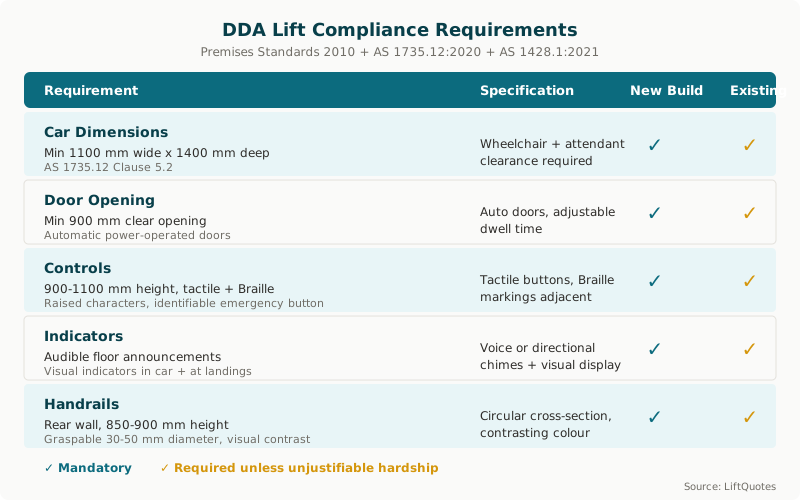
The Premises Standards reference AS 1735.12:2020 (lifts for persons with disabilities) and AS 1428.1:2021 (general requirements for access) for the technical specification of DDA-compliant lifts. The key requirements fall into five categories.
Car dimensions: The lift car must be at least 1100 mm wide and 1400 mm deep to accommodate a wheelchair user and an attendant. These are minimum internal dimensions — larger is acceptable, smaller is not. For stretcher-capable lifts in healthcare settings, the minimum depth increases to 2300 mm.
Door openings: A minimum clear opening of 900 mm is required for the lift car doors. Doors must be automatic power-operated — no manual gates or sliding doors. The door dwell time must be adjustable and sufficient for a wheelchair user to enter without the doors closing prematurely.
Controls: Call buttons and car operating panels must be mounted between 900 mm and 1100 mm above finished floor level. Buttons must be tactile, with raised characters and Braille markings adjacent to each button. The emergency call button, alarm, and door-open button must be clearly identifiable by shape, colour, and tactile marking.
Indicators: Audible floor announcements are required — either a voice announcement or a sequential chime system that indicates the direction of travel and the floor reached. Visual floor indicators must be provided both inside the car and at each landing. Landing indicators must show the direction of travel.
Handrails: A handrail is required on the rear wall of the car, mounted at 850 mm to 900 mm above the car floor. The handrail must be graspable (circular cross-section, 30 mm to 50 mm diameter) and contrast visually with the wall behind it.
For a broader view of the Australian lift standards framework — including Layer A building compliance and Layer C workplace safety obligations — see the full standards guide.
Building classes and the NCC trigger
Not every building requires a DDA-compliant lift. The requirement is linked to the building classification under the NCC and the nature of access provided.
Class 5–9 buildings (commercial, retail, industrial, healthcare, assembly): If the building has more than one storey providing access to the public or occupants, a lift is required as part of the accessible path of travel. This is the most common DDA lift trigger for commercial lift installations.
Class 2 buildings (apartments): A lift connecting common areas on different levels is required. Individual apartments above the entry level do not require lift access under the Premises Standards — though some states have introduced additional requirements through planning overlays or the Livable Housing Design Standard.
Class 1 (houses) and Class 10 (sheds, garages): The Premises Standards do not apply. Residential homes are not captured unless they include a commercial component (e.g., a home office open to the public). However, platform lifts for accessibility are commonly installed in residential settings through NDIS or aged care funding pathways.
The unjustifiable hardship defence
Under section 11 of the DDA, a building owner can argue that compliance with the access requirements would impose unjustifiable hardship. This is not a blanket exemption — it is a defence that must be proven if a complaint is lodged.
The factors considered include the financial circumstances of the respondent, the cost of compliance relative to the overall project cost, the nature of the benefit or detriment to the complainant, and the availability of alternative access.
In practice, unjustifiable hardship is most relevant for existing buildings where structural constraints make a conventional lift installation disproportionately expensive. Heritage-listed buildings, buildings with inadequate structural capacity for a shaft, and small commercial premises with very limited floor area are the most common scenarios.
The defence does not apply to new buildings. If you are building new, you must comply — there is no hardship argument available at the design stage. The cost of compliance is expected to be factored into the project budget from inception.
For existing buildings considering a lift modernisation to improve accessibility, the question is often whether the current lift meets the AS 1735.12 specification or whether it predates the standard and lacks required features like tactile controls, Braille, or audible indicators.
Practical compliance steps for building owners
If you are a building owner or facility manager assessing DDA lift compliance, start here:
- Identify your building class under the NCC. This determines whether the Premises Standards apply.
- Determine the trigger. Is this a new building, a renovation requiring building approval, or an existing building responding to a complaint?
- Assess the current lift specification against AS 1735.12:2020. Does the car meet minimum dimensions? Are controls at the correct height with tactile and Braille markings? Are audible indicators provided?
- Engage an access consultant for a formal assessment. They will map the accessible path of travel and identify gaps.
- Get lift quotes for any required upgrades. A controls-and-indicators upgrade is substantially cheaper than a full lift replacement.
LiftQuotes does not provide legal or compliance advice. Verify requirements with your state building authority or a qualified access consultant. The Premises Standards are published on legislation.gov.au, and AS 1735.12:2020 is available through Standards Australia.
If your building needs a DDA-compliant lift or an accessibility upgrade to an existing lift, get free quotes from qualified Australian lift installers to compare specifications, timelines, and pricing for your project.
Lift companies in Australia
Browse profiles, compare service areas, and check reviews.

Lift Shop
★ 5.0 (1551 reviews)
Australia's largest dedicated home lift specialist since 1996. 10,000+ installations. Exclusive Italian-crafted lifts with industry-leading 8-year warranty.
View profile →

Compact Home Lifts
NDIS★ 5.0 (465 reviews)
Melbourne branch of Compact Home Lifts. Compact residential lift specialist providing maintenance and repair services across Victoria.
View profile →

Next Level Elevators
★ 5.0 (454 reviews)
Award-winning provider of premium Italian-designed all-electric home elevators. Certified Eltec Partner. Showrooms in Melbourne, Sydney, and Brisbane.
View profile →

Shotton Lifts
NDIS★ 5.0 (9 reviews)
Family-owned Australian lift manufacturer since 1977. 80+ staff. Design, engineer, manufacture, install and service from Dandenong South VIC. NDIS registered.
View profile →

LiftFit Australia
NDIS★ 5.0 (8 reviews)
Victoria-based NDIS registered lift provider, est. 2011. Partners with Cibes, Savaria, and Kalea. Residential, commercial, and platform lifts.
View profile →

Easy Living Home Elevators
★ 5.0 (7 reviews)
Australia's #1 home elevator supplier since 1998. 100% Australian-owned. 11,000+ elevators in service across 6 states.
View profile →
LiftQuotes is a comparison platform. Companies shown are filtered by relevance to this page. Listing does not imply endorsement. LiftQuotes may receive a referral fee when you request quotes.
Put this into action
When you're ready to move forward, get free quotes from verified Australian lift installers.
What are you looking for today?
I need a lift installed
I have a lift that needs attention
When DDA lift access is required
The Premises Standards apply to new buildings and existing buildings undergoing renovation or a change of use. Whether a lift is specifically required depends on the building class under the NCC and the number of storeys providing direct access to the public or to building occupants.
For new Class 5 (office), Class 6 (retail), Class 7b (storage with public access), Class 8 (laboratory/factory with public areas), and Class 9 (healthcare, assembly, aged care) buildings with more than one storey, the NCC requires an accessible path of travel between all storeys that the public or occupants use. In practice, this means a DDA-compliant lift or ramp. A ramp is only feasible for single-level changes — anything above one storey requires a lift.
For Class 2 (apartments) and Class 3 (residential buildings like hotels) with a common area above or below the entrance storey, an accessible path of travel must connect all common areas. A lift is required where the common area spans multiple levels and a ramp is impractical.
Existing buildings are captured when they undergo a renovation that triggers a building approval. The threshold varies by jurisdiction, but the general principle is this: if the renovation is substantial enough to require a building permit, the Premises Standards require that the affected areas — and often the path of travel to those areas — be brought up to current access standards.
What the Premises Standards require for lifts
The Premises Standards reference AS 1735.12:2020 (lifts for persons with disabilities) and AS 1428.1:2021 (general requirements for access) for the technical specification of DDA-compliant lifts. The key requirements fall into five categories.
Car dimensions: The lift car must be at least 1100 mm wide and 1400 mm deep to accommodate a wheelchair user and an attendant. These are minimum internal dimensions — larger is acceptable, smaller is not. For stretcher-capable lifts in healthcare settings, the minimum depth increases to 2300 mm.
Door openings: A minimum clear opening of 900 mm is required for the lift car doors. Doors must be automatic power-operated — no manual gates or sliding doors. The door dwell time must be adjustable and sufficient for a wheelchair user to enter without the doors closing prematurely.
Controls: Call buttons and car operating panels must be mounted between 900 mm and 1100 mm above finished floor level. Buttons must be tactile, with raised characters and Braille markings adjacent to each button. The emergency call button, alarm, and door-open button must be clearly identifiable by shape, colour, and tactile marking.
Indicators: Audible floor announcements are required — either a voice announcement or a sequential chime system that indicates the direction of travel and the floor reached. Visual floor indicators must be provided both inside the car and at each landing. Landing indicators must show the direction of travel.
Handrails: A handrail is required on the rear wall of the car, mounted at 850 mm to 900 mm above the car floor. The handrail must be graspable (circular cross-section, 30 mm to 50 mm diameter) and contrast visually with the wall behind it.
For a broader view of the Australian lift standards framework — including Layer A building compliance and Layer C workplace safety obligations — see the full standards guide.
Building classes and the NCC trigger
Not every building requires a DDA-compliant lift. The requirement is linked to the building classification under the NCC and the nature of access provided.
Class 5–9 buildings (commercial, retail, industrial, healthcare, assembly): If the building has more than one storey providing access to the public or occupants, a lift is required as part of the accessible path of travel. This is the most common DDA lift trigger for commercial lift installations.
Class 2 buildings (apartments): A lift connecting common areas on different levels is required. Individual apartments above the entry level do not require lift access under the Premises Standards — though some states have introduced additional requirements through planning overlays or the Livable Housing Design Standard.
Class 1 (houses) and Class 10 (sheds, garages): The Premises Standards do not apply. Residential homes are not captured unless they include a commercial component (e.g., a home office open to the public). However, platform lifts for accessibility are commonly installed in residential settings through NDIS or aged care funding pathways.
The unjustifiable hardship defence
Under section 11 of the DDA, a building owner can argue that compliance with the access requirements would impose unjustifiable hardship. This is not a blanket exemption — it is a defence that must be proven if a complaint is lodged.
The factors considered include the financial circumstances of the respondent, the cost of compliance relative to the overall project cost, the nature of the benefit or detriment to the complainant, and the availability of alternative access.
In practice, unjustifiable hardship is most relevant for existing buildings where structural constraints make a conventional lift installation disproportionately expensive. Heritage-listed buildings, buildings with inadequate structural capacity for a shaft, and small commercial premises with very limited floor area are the most common scenarios.
The defence does not apply to new buildings. If you are building new, you must comply — there is no hardship argument available at the design stage. The cost of compliance is expected to be factored into the project budget from inception.
For existing buildings considering a lift modernisation to improve accessibility, the question is often whether the current lift meets the AS 1735.12 specification or whether it predates the standard and lacks required features like tactile controls, Braille, or audible indicators.
Practical compliance steps for building owners
If you are a building owner or facility manager assessing DDA lift compliance, start here:
- Identify your building class under the NCC. This determines whether the Premises Standards apply.
- Determine the trigger. Is this a new building, a renovation requiring building approval, or an existing building responding to a complaint?
- Assess the current lift specification against AS 1735.12:2020. Does the car meet minimum dimensions? Are controls at the correct height with tactile and Braille markings? Are audible indicators provided?
- Engage an access consultant for a formal assessment. They will map the accessible path of travel and identify gaps.
- Get lift quotes for any required upgrades. A controls-and-indicators upgrade is substantially cheaper than a full lift replacement.
LiftQuotes does not provide legal or compliance advice. Verify requirements with your state building authority or a qualified access consultant. The Premises Standards are published on legislation.gov.au, and AS 1735.12:2020 is available through Standards Australia.
If your building needs a DDA-compliant lift or an accessibility upgrade to an existing lift, get free quotes from qualified Australian lift installers to compare specifications, timelines, and pricing for your project.
Lift companies in Australia
Browse profiles, compare service areas, and check reviews.
Lift Shop
★ 5.0 (1551 reviews)
Australia's largest dedicated home lift specialist since 1996. 10,000+ installations. Exclusive Italian-crafted lifts with industry-leading 8-year warranty.
View profile →
Compact Home Lifts
NDIS★ 5.0 (465 reviews)
Melbourne branch of Compact Home Lifts. Compact residential lift specialist providing maintenance and repair services across Victoria.
View profile →
Next Level Elevators
★ 5.0 (454 reviews)
Award-winning provider of premium Italian-designed all-electric home elevators. Certified Eltec Partner. Showrooms in Melbourne, Sydney, and Brisbane.
View profile →
Shotton Lifts
NDIS★ 5.0 (9 reviews)
Family-owned Australian lift manufacturer since 1977. 80+ staff. Design, engineer, manufacture, install and service from Dandenong South VIC. NDIS registered.
View profile →
LiftFit Australia
NDIS★ 5.0 (8 reviews)
Victoria-based NDIS registered lift provider, est. 2011. Partners with Cibes, Savaria, and Kalea. Residential, commercial, and platform lifts.
View profile →
Easy Living Home Elevators
★ 5.0 (7 reviews)
Australia's #1 home elevator supplier since 1998. 100% Australian-owned. 11,000+ elevators in service across 6 states.
View profile →
LiftQuotes is a comparison platform. Companies shown are filtered by relevance to this page. Listing does not imply endorsement. LiftQuotes may receive a referral fee when you request quotes.
Put this into action
When you're ready to move forward, get free quotes from verified Australian lift installers.
What are you looking for today?
I need a lift installed
I have a lift that needs attention
Premises Standards set the threshold
The Disability (Access to Premises — Buildings) Standards 2010 define when lift access is required and what specifications the lift must meet. They reference the NCC and AS 1735.12.
New buildings vs existing buildings
New buildings and major renovations must comply fully. Existing buildings must comply to the extent that not doing so would constitute unjustifiable hardship.
AS 1735.12:2020 governs the lift spec
Car dimensions, door openings, control heights, tactile buttons, Braille markings, audible indicators, and handrails are all specified in this standard.
Unjustifiable hardship is a legal defence
Building owners can claim unjustifiable hardship if compliance would impose disproportionate cost or difficulty — but the burden of proof sits with the owner, not the complainant.
Common questions about DDA lift compliance
DDA compliance for lifts means the lift meets the technical requirements set out in the Disability (Access to Premises — Buildings) Standards 2010 and the referenced standards — primarily AS 1735.12:2020 (lifts for persons with disabilities) and AS 1428.1:2021 (general access requirements). In practical terms, this covers minimum car dimensions (1100 mm x 1400 mm), automatic doors with at least 900 mm clear opening, controls mounted at 900–1100 mm height with tactile buttons and Braille, audible floor indicators, and a rear-wall handrail. A DDA-compliant lift provides independent, equitable access for people using wheelchairs, mobility aids, or who have vision impairment.
Related guides
Location
Commercial Lifts Melbourne: Costs, Compliance & Installers
Commercial lift costs, Victorian OHS compliance and the Melbourne installer market — indicative prices, WorkSafe Victoria rules and NCC requirements for VIC projects.
Location
Commercial Lifts Sydney: Costs, Compliance & Installers
Commercial lift costs, NSW compliance and the Sydney installer market — indicative prices, SafeWork NSW rules and NCC requirements for CBD and metro projects.
Guide
What Size Lift Do I Need for a Wheelchair? (Australia)
A home lift for a wheelchair needs roughly 1,100 x 1,400 mm inside and a 900 mm clear door. See minimum sizes for a wheelchair, a carer, and turning space.
Guide
Support at Home & Lift Funding: The 2026 Guide
Can Support at Home fund a home lift or stairlift? How aged care funding works, the OT assessment, means-tested contributions, and how it differs from the NDIS.
Need a DDA-compliant lift?
Whether you are installing a new lift for a commercial development or upgrading an existing lift to meet the Premises Standards, compare quotes from qualified Australian lift installers who specialise in DDA-compliant installations.
Join 1,000+ Australians who've requested quotes through LiftQuotes
Get free quotes