
Lift Companies in Australia Compared
Australia has more than 70 lift companies — from global OEMs like Schindler and KONE to specialist residential installers. This independent comparison helps you understand the three main supplier categories and choose the right type for your project.
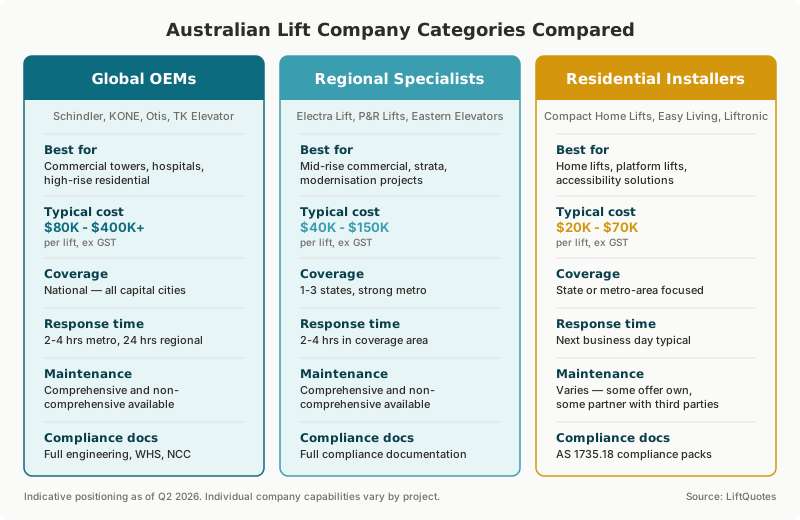
Choosing a lift company in Australia is not just about picking a brand. The Australian market has three distinct categories of supplier — global OEMs, regional service specialists, and residential lift installers — and each operates differently in terms of pricing, service coverage, and the types of projects they handle.
This is not a ranking. No single company is "best" for every project. A Schindler or KONE makes sense for a 20-storey commercial tower. A specialist residential installer is a better fit for a two-stop home lift. Understanding how the market is structured is the first step to getting the right quotes from the right companies.
The Australian lift market breaks into three broad categories. Each has different strengths, coverage, and typical project types.
Swipe to compare →
| Factor | Global OEMs | Regional Specialists | Residential Installers |
|---|---|---|---|
| Best for | Commercial towers, hospitals, high-rise residential | Mid-rise commercial, strata, modernisation | Home lifts, platform lifts, accessibility |
| Examples active in AU | Schindler, KONE, Otis, TK Elevator | Electra Lift, P&R Lifts, Eastern Elevators | Compact Home Lifts, Easy Living, Liftronic |
| Typical project size | $80,000–$400,000+ per lift | $40,000–$150,000 per lift | $20,000–$70,000 per lift |
| Service coverage | National — all capital cities | 1–3 states, strong metro coverage | State or metro-area focused |
| Maintenance contracts | Comprehensive and non-comprehensive available | Comprehensive and non-comprehensive available | Varies — some offer, some partner with third parties |
| Response time (typical SLA) | 2–4 hours metro, 24 hours regional | 2–4 hours in coverage area | Next business day is common |
| Custom design capability | Full custom specification for commercial | Moderate — adapt standard platforms | Cabin finishes, sizes, and door configurations |
| Compliance documentation | Full engineering, WHS, and NCC documentation | Full compliance documentation | AS 1735.18 compliance packs standard |
Company examples are illustrative and based on publicly available information. Inclusion does not imply endorsement. Data reflects general market positioning as of Q2 2026 — individual company capabilities vary by project.
Lift companies in Australia
Browse profiles, compare service areas, and check reviews.

Lift Shop
★ 5.0 (1551 reviews)
Australia's largest dedicated home lift specialist since 1996. 10,000+ installations. Exclusive Italian-crafted lifts with industry-leading 8-year warranty.
View profile →

Compact Home Lifts
NDIS★ 5.0 (465 reviews)
Melbourne branch of Compact Home Lifts. Compact residential lift specialist providing maintenance and repair services across Victoria.
View profile →

Next Level Elevators
★ 5.0 (454 reviews)
Award-winning provider of premium Italian-designed all-electric home elevators. Certified Eltec Partner. Showrooms in Melbourne, Sydney, and Brisbane.
View profile →

Shotton Lifts
NDIS★ 5.0 (9 reviews)
Family-owned Australian lift manufacturer since 1977. 80+ staff. Design, engineer, manufacture, install and service from Dandenong South VIC. NDIS registered.
View profile →

LiftFit Australia
NDIS★ 5.0 (8 reviews)
Victoria-based NDIS registered lift provider, est. 2011. Partners with Cibes, Savaria, and Kalea. Residential, commercial, and platform lifts.
View profile →

Easy Living Home Elevators
★ 5.0 (7 reviews)
Australia's #1 home elevator supplier since 1998. 100% Australian-owned. 11,000+ elevators in service across 6 states.
View profile →
LiftQuotes is a comparison platform. Companies shown are filtered by relevance to this page. Listing does not imply endorsement. LiftQuotes may receive a referral fee when you request quotes.
How the Australian lift market is structured
Australia's lift industry includes more than 70 active companies, ranging from divisions of global manufacturers to owner-operated businesses serving a single metro area. The market is not as consolidated as it might appear — while a handful of OEMs dominate commercial high-rise work, the residential and low-rise segments are served by dozens of smaller specialists.
The LiftQuotes company directory tracks 78 verified lift companies operating across all states and territories. Understanding which category a company falls into helps you shortlist the right suppliers for your specific project.
Global OEMs — Schindler, KONE, Otis, TK Elevator
The four major original equipment manufacturers — Schindler, KONE, Otis, and TK Elevator (formerly ThyssenKrupp) — have Australian operations with national coverage. These companies manufacture their own lift systems, maintain large field service teams, and handle projects from specification through to ongoing lift maintenance.
OEMs are the default choice for commercial high-rise, hospital, and large residential tower projects. Their strength is engineering depth, parts supply chains, and the ability to service what they install nationwide. The trade-off is pricing: OEM commercial lifts typically start from $80,000 per unit installed, and their maintenance contracts reflect the overhead of national operations.
Schindler is the most searched lift brand in Australia ("Schindler lifts" sees 1,600+ monthly searches), followed by KONE and Otis. Brand recognition matters less than you might think for the actual purchasing decision — what matters is whether the company's standard product range fits your building's requirements and whether their service coverage reaches your location.
Regional service specialists
Regional specialists are typically Australian-owned companies that operate across one to three states. They may manufacture their own platforms, or distribute and install products from European or Asian manufacturers. Companies like Electra Lift, P&R Lifts, and Eastern Elevators fit this category.
These companies compete on responsiveness, price, and local knowledge. They often handle the mid-rise commercial and strata segments that sit between high-rise OEM territory and residential specialist territory. For lift modernisation projects in strata buildings, regional specialists are frequently the most competitive option because they carry lower overhead than OEMs while offering comparable compliance documentation.
Regional specialists typically offer both comprehensive and non-comprehensive maintenance contracts. Their service response times in their coverage area are often faster than OEMs — a company with 30 technicians across Sydney can often respond faster than a national operation managing thousands of units.
Residential lift installers
Residential installers focus on home lifts, platform lifts, and accessibility solutions. Companies like Compact Home Lifts, Easy Living, and Liftronic specialise in the $20,000–$70,000 segment and typically serve a single state or metro area.
These companies work with European manufacturers (Aritco, Cibes, Kalea, Stiltz) or distribute locally assembled platforms. Their value is in residential experience: understanding building approval requirements for home installations, managing the structural works interface, and specifying lifts that comply with AS/NZS 1735.18:2002 — the Australian Standard covering passenger lifts in private residences.
For a home lift cost comparison, residential installers almost always offer better pricing than an OEM for the same project. They are also more likely to handle the full scope — lift supply, building works coordination, and compliance documentation — as a single point of contact.
How to choose the right type of company
The decision framework is simpler than the number of companies suggests:
Choose a global OEM if: your project is a commercial building over 4 storeys, you need a stretcher or hospital lift, or the building specification nominates an OEM product. You should also consider OEMs if national maintenance coverage matters — for example, a retail chain with lifts in multiple states.
Choose a regional specialist if: your project is a mid-rise commercial building, a strata modernisation, or a DDA compliance upgrade. Regional specialists are often the best balance of capability and cost for these projects.
Choose a residential installer if: you need a home lift, platform lift, or accessibility solution for a residential property. These companies understand the residential approval process, offer competitive pricing in the $20,000–$70,000 range, and typically manage the full installation scope.
What to check before getting quotes
Regardless of which category, verify these before committing:
- Licensing and insurance: Confirm the company holds the required licences for your state. Lift installation involves registrable plant under WHS regulations — the company must be able to provide design registration documentation.
- Service coverage: Ensure the company services your location for ongoing maintenance, not just installation. A company that installs but cannot maintain creates a problem later.
- Reference projects: Ask for completed projects similar to yours in type and scale. A company that mainly installs commercial lifts may not be the best fit for a residential retrofit.
- Maintenance terms: Understand whether they offer comprehensive or non-comprehensive contracts, and what each includes. This directly affects your ongoing lift costs.
- Compliance documentation: The company should provide full compliance documentation including design registration, installation certificates, and handover manuals.

The most reliable way to compare is to get quotes from at least two companies in the relevant category for your project. The LiftQuotes company directory lets you filter by location, lift type, and service area to find companies that match your requirements.
Still deciding? Get quotes for both options
Installers will assess your site and recommend the right specification.
What are you looking for today?
I need a lift installed
I have a lift that needs attention
Choosing a lift company in Australia is not just about picking a brand. The Australian market has three distinct categories of supplier — global OEMs, regional service specialists, and residential lift installers — and each operates differently in terms of pricing, service coverage, and the types of projects they handle.
This is not a ranking. No single company is "best" for every project. A Schindler or KONE makes sense for a 20-storey commercial tower. A specialist residential installer is a better fit for a two-stop home lift. Understanding how the market is structured is the first step to getting the right quotes from the right companies.
The Australian lift market breaks into three broad categories. Each has different strengths, coverage, and typical project types.
Swipe to compare →
| Factor | Global OEMs | Regional Specialists | Residential Installers |
|---|---|---|---|
| Best for | Commercial towers, hospitals, high-rise residential | Mid-rise commercial, strata, modernisation | Home lifts, platform lifts, accessibility |
| Examples active in AU | Schindler, KONE, Otis, TK Elevator | Electra Lift, P&R Lifts, Eastern Elevators | Compact Home Lifts, Easy Living, Liftronic |
| Typical project size | $80,000–$400,000+ per lift | $40,000–$150,000 per lift | $20,000–$70,000 per lift |
| Service coverage | National — all capital cities | 1–3 states, strong metro coverage | State or metro-area focused |
| Maintenance contracts | Comprehensive and non-comprehensive available | Comprehensive and non-comprehensive available | Varies — some offer, some partner with third parties |
| Response time (typical SLA) | 2–4 hours metro, 24 hours regional | 2–4 hours in coverage area | Next business day is common |
| Custom design capability | Full custom specification for commercial | Moderate — adapt standard platforms | Cabin finishes, sizes, and door configurations |
| Compliance documentation | Full engineering, WHS, and NCC documentation | Full compliance documentation | AS 1735.18 compliance packs standard |
Company examples are illustrative and based on publicly available information. Inclusion does not imply endorsement. Data reflects general market positioning as of Q2 2026 — individual company capabilities vary by project.
Lift companies in Australia
Browse profiles, compare service areas, and check reviews.
Lift Shop
★ 5.0 (1551 reviews)
Australia's largest dedicated home lift specialist since 1996. 10,000+ installations. Exclusive Italian-crafted lifts with industry-leading 8-year warranty.
View profile →
Compact Home Lifts
NDIS★ 5.0 (465 reviews)
Melbourne branch of Compact Home Lifts. Compact residential lift specialist providing maintenance and repair services across Victoria.
View profile →
Next Level Elevators
★ 5.0 (454 reviews)
Award-winning provider of premium Italian-designed all-electric home elevators. Certified Eltec Partner. Showrooms in Melbourne, Sydney, and Brisbane.
View profile →
Shotton Lifts
NDIS★ 5.0 (9 reviews)
Family-owned Australian lift manufacturer since 1977. 80+ staff. Design, engineer, manufacture, install and service from Dandenong South VIC. NDIS registered.
View profile →
LiftFit Australia
NDIS★ 5.0 (8 reviews)
Victoria-based NDIS registered lift provider, est. 2011. Partners with Cibes, Savaria, and Kalea. Residential, commercial, and platform lifts.
View profile →
Easy Living Home Elevators
★ 5.0 (7 reviews)
Australia's #1 home elevator supplier since 1998. 100% Australian-owned. 11,000+ elevators in service across 6 states.
View profile →
LiftQuotes is a comparison platform. Companies shown are filtered by relevance to this page. Listing does not imply endorsement. LiftQuotes may receive a referral fee when you request quotes.
How the Australian lift market is structured
Australia's lift industry includes more than 70 active companies, ranging from divisions of global manufacturers to owner-operated businesses serving a single metro area. The market is not as consolidated as it might appear — while a handful of OEMs dominate commercial high-rise work, the residential and low-rise segments are served by dozens of smaller specialists.
The LiftQuotes company directory tracks 78 verified lift companies operating across all states and territories. Understanding which category a company falls into helps you shortlist the right suppliers for your specific project.
Global OEMs — Schindler, KONE, Otis, TK Elevator
The four major original equipment manufacturers — Schindler, KONE, Otis, and TK Elevator (formerly ThyssenKrupp) — have Australian operations with national coverage. These companies manufacture their own lift systems, maintain large field service teams, and handle projects from specification through to ongoing lift maintenance.
OEMs are the default choice for commercial high-rise, hospital, and large residential tower projects. Their strength is engineering depth, parts supply chains, and the ability to service what they install nationwide. The trade-off is pricing: OEM commercial lifts typically start from $80,000 per unit installed, and their maintenance contracts reflect the overhead of national operations.
Schindler is the most searched lift brand in Australia ("Schindler lifts" sees 1,600+ monthly searches), followed by KONE and Otis. Brand recognition matters less than you might think for the actual purchasing decision — what matters is whether the company's standard product range fits your building's requirements and whether their service coverage reaches your location.
Regional service specialists
Regional specialists are typically Australian-owned companies that operate across one to three states. They may manufacture their own platforms, or distribute and install products from European or Asian manufacturers. Companies like Electra Lift, P&R Lifts, and Eastern Elevators fit this category.
These companies compete on responsiveness, price, and local knowledge. They often handle the mid-rise commercial and strata segments that sit between high-rise OEM territory and residential specialist territory. For lift modernisation projects in strata buildings, regional specialists are frequently the most competitive option because they carry lower overhead than OEMs while offering comparable compliance documentation.
Regional specialists typically offer both comprehensive and non-comprehensive maintenance contracts. Their service response times in their coverage area are often faster than OEMs — a company with 30 technicians across Sydney can often respond faster than a national operation managing thousands of units.
Residential lift installers
Residential installers focus on home lifts, platform lifts, and accessibility solutions. Companies like Compact Home Lifts, Easy Living, and Liftronic specialise in the $20,000–$70,000 segment and typically serve a single state or metro area.
These companies work with European manufacturers (Aritco, Cibes, Kalea, Stiltz) or distribute locally assembled platforms. Their value is in residential experience: understanding building approval requirements for home installations, managing the structural works interface, and specifying lifts that comply with AS/NZS 1735.18:2002 — the Australian Standard covering passenger lifts in private residences.
For a home lift cost comparison, residential installers almost always offer better pricing than an OEM for the same project. They are also more likely to handle the full scope — lift supply, building works coordination, and compliance documentation — as a single point of contact.
How to choose the right type of company
The decision framework is simpler than the number of companies suggests:
Choose a global OEM if: your project is a commercial building over 4 storeys, you need a stretcher or hospital lift, or the building specification nominates an OEM product. You should also consider OEMs if national maintenance coverage matters — for example, a retail chain with lifts in multiple states.
Choose a regional specialist if: your project is a mid-rise commercial building, a strata modernisation, or a DDA compliance upgrade. Regional specialists are often the best balance of capability and cost for these projects.
Choose a residential installer if: you need a home lift, platform lift, or accessibility solution for a residential property. These companies understand the residential approval process, offer competitive pricing in the $20,000–$70,000 range, and typically manage the full installation scope.
What to check before getting quotes
Regardless of which category, verify these before committing:
- Licensing and insurance: Confirm the company holds the required licences for your state. Lift installation involves registrable plant under WHS regulations — the company must be able to provide design registration documentation.
- Service coverage: Ensure the company services your location for ongoing maintenance, not just installation. A company that installs but cannot maintain creates a problem later.
- Reference projects: Ask for completed projects similar to yours in type and scale. A company that mainly installs commercial lifts may not be the best fit for a residential retrofit.
- Maintenance terms: Understand whether they offer comprehensive or non-comprehensive contracts, and what each includes. This directly affects your ongoing lift costs.
- Compliance documentation: The company should provide full compliance documentation including design registration, installation certificates, and handover manuals.
The most reliable way to compare is to get quotes from at least two companies in the relevant category for your project. The LiftQuotes company directory lets you filter by location, lift type, and service area to find companies that match your requirements.
Still deciding? Get quotes for both options
Installers will assess your site and recommend the right specification.
What are you looking for today?
I need a lift installed
I have a lift that needs attention
70+ active lift companies
The Australian market includes global OEMs, regional specialists, and residential installers — each serving different project types and budgets.
No single "best" company
The right supplier depends on your project type: commercial high-rise, mid-rise strata, or residential home lift. Match the company category to the project.
Get at least two quotes
Compare companies within the same category. An OEM quote and a residential installer quote are not comparable — they serve fundamentally different market segments.
Common Questions About Lift Companies in Australia
There is no single best home lift company for every situation. The right choice depends on your budget, location, and project requirements. Residential specialists like Compact Home Lifts, Easy Living, and Liftronic focus on the home market and typically offer better pricing and residential experience than global OEMs. Get quotes from at least two residential installers to compare.
Related guides
Guide
Lift Plant Registration: State-by-State Requirements in Australia
State-by-state lift plant registration requirements — which regulator handles design and item registration, WHS vs OHS frameworks, and why Victoria is the exception.
Guide
Home Lifts for Elderly & Ageing in Place: What to Consider
Practical guide to choosing a home lift for elderly family members. Covers safety features, costs, funding options, and future-proofing for ageing in place.
home lifts · Comparison
Home Lift vs Stairlift: Cost, Space & Suitability Compared
Stairlifts cost $5,000–$15,000 installed. Home lifts cost $20,000–$70,000. Compare space, wheelchair access, resale value and ongoing costs side by side.
home lifts · Cost guide
Stairlift Cost in Australia: $3,000–$15,000+ (2026 Prices)
How much does a stairlift cost in Australia? Straight stairlifts from $3,000, curved from $8,000. New, reconditioned, and rental pricing compared.
Ready to compare lift companies?
Tell us about your project and we will connect you with verified lift companies in your area — free, with no obligation.
Join 1,000+ Australians who've requested quotes through LiftQuotes
Get free quotes